
 Jay Wile
[Originally published in 2013 as Astronomers are Finally Starting to Question an Absurd Assumption]
One of the more absurd assumptions that is routinely made in astronomy is called the cosmological principle. One way to phrase the principle is:
Viewed on a large enough scale, the properties of the universe are the same no matter where you are.
Advertisement Below:
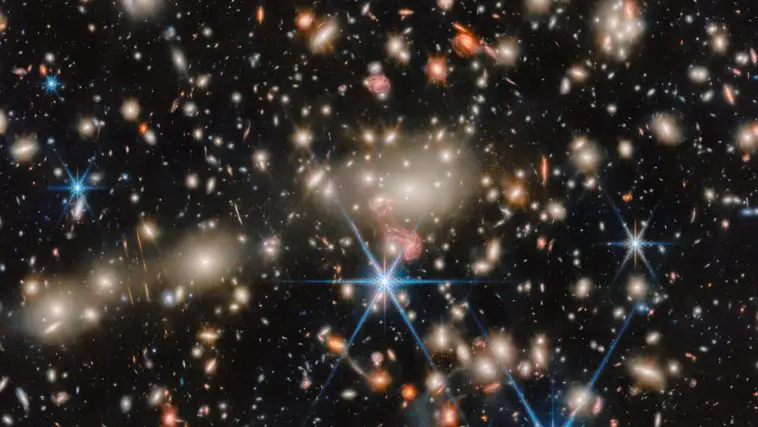
However, observations have never supported this assumption. Instead, the observable universe seems incredibly “lumpy,” with huge structures separated by vast areas devoid of structures. Nevertheless, cosmologists have doggedly taken the cosmological principle as their starting assumption when it comes to developing models of the universe, despite the fact that observations don’t support it.
Indeed, the cosmological principle is a necessary starting point for the Big Bang, which most, but certainly not all, astronomers think is a good description of the origin and development of the universe. As Paul Fleisher says in his book, The Big Bang:1
The cosmological principle is the central idea of the Big Bang theory. This rule says the universe is homogeneous and isotropic at very large scales.
Even if we go away from the Big Bang model, the vast majority of models that attempt to describe the universe start with the assumption that the cosmological principle is valid. There are some models that do not start with that assumption, but they are few and far between.2
I have always been skeptical of the cosmological principle, simply because it isn’t supported by observation. The universe doesn’t look homogeneous at all. Instead, it looks really “lumpy.” Nevertheless, when I read the scientific literature, the cosmological principle seems to be considered a fact in almost all of the astronomy-related papers.
It looks like that might be starting to change.
Roger G. Clowes and his colleagues report on their observation of what they call the Huge-LQG.3 It is a collection of 73 quasars, which are thought to be very bright, active centers of distant galaxies. It is thought that the properties of quasars are best explained by the presence of a supermassive black hole, whose mass is in excess of a billion times the mass of our sun. Obviously, that’s a lot of mass, and it is thought to be an integral part of any quasar.

So quasars are incredibly massive structures. While other large groups of quasars (known as LQGs) have been found, they generally consist of 5-40 members. In this figure, for example, the red crosses represent a LQG known as the Clowes & Campusano LQG, or CCLQG. It consists of 34 quasars lumped together.
The group of quasars that were discovered by Clowes and his colleagues in this report is represented by the black circles in the figure. It is more than twice as big as the CCLQG, containing 73 quasars! That’s why they call it the Huge-LQG. It is a huge large quasar group. The fact that astronomers have to put “huge” and “large” together to describe this group of quasars gives you an idea of how big it really is!
Now, of course, the fact that it is big is quite interesting. Indeed, its longest dimension is 1200 Megaparsecs or 4 billion light years across. However, the really interesting part is that this structure is so big that it causes the authors to question the cosmological principle. In their article, they discuss the calculations of Jaswant K. Yadav and his colleagues, which say that the cosmological principle predicts that no structure in the universe should exceed a size of about 370 Megaparsecs.4 Not only does the Huge-LQG significantly exceed that size, it seems to be in very close proximity to the CCLQG, indicating that this region of space is incredibly “lumpy” compared to other regions of space. Here’s how the authors put it:
In summary, the Huge-LQG presents an interesting potential challenge to the assumption of homogeneity in the cosmological principle. Its proximity to the CCLQG at the same redshift adds to that challenge.
I hope that what I read in this paper represents a trend. Rather than taking the cosmological principle as a blind assumption, astronomers should evaluate it in light of the data. Right now, the data strongly argue against the cosmological principle, which should tell you something about any model (like the Big Bang) that requires its assumption.
References
- Paul Fleisher, The Big Bang, Twenty-First Century Books 2006, p. 44
- Andersson, Lars and Coley, Alan, “Inhomogeneous cosmological models and averaging in cosmology: overview,” Classical and Quantum Gravity 28(16):160301, 2011. (PDF available online)
- Roger G. Clowes, Kathryn A. Harris, Srinivasan Raghunathan, Luis E. Campusano, Ilona K. Söchting, and Matthew J. Graham, “A structure in the early Universe at z ∼ 1.3 that exceeds the homogeneity scale of the R-W concordance cosmology,” Monthly Notices of the Royal Astronomical Society, 2013
- Jaswant K. Yadav, J. S. Bagla, and Nishikanta Khandai, “Fractal dimension as a measure of the scale of homogeneity,” Monthly Notices of the Royal Astronomical Society, 2010
[Editor’s note: In the intervening years, an even larger structure has been located, labeled the Hercules–Corona Borealis Great Wall (HCB).