
 Cheri Fields
[Originally published as the first section of TCQ Week 5: Astronomy and the Bible]
Until now, we’ve looked at the big picture of science and the Bible. We’ve discussed why Christians should care about science, what science is, how science fits with a supernatural worldview, and the age of the earth.
Starting this week, we’ll explore different areas of science in more detail, starting with astronomy.
The Heavens and the Ancient World
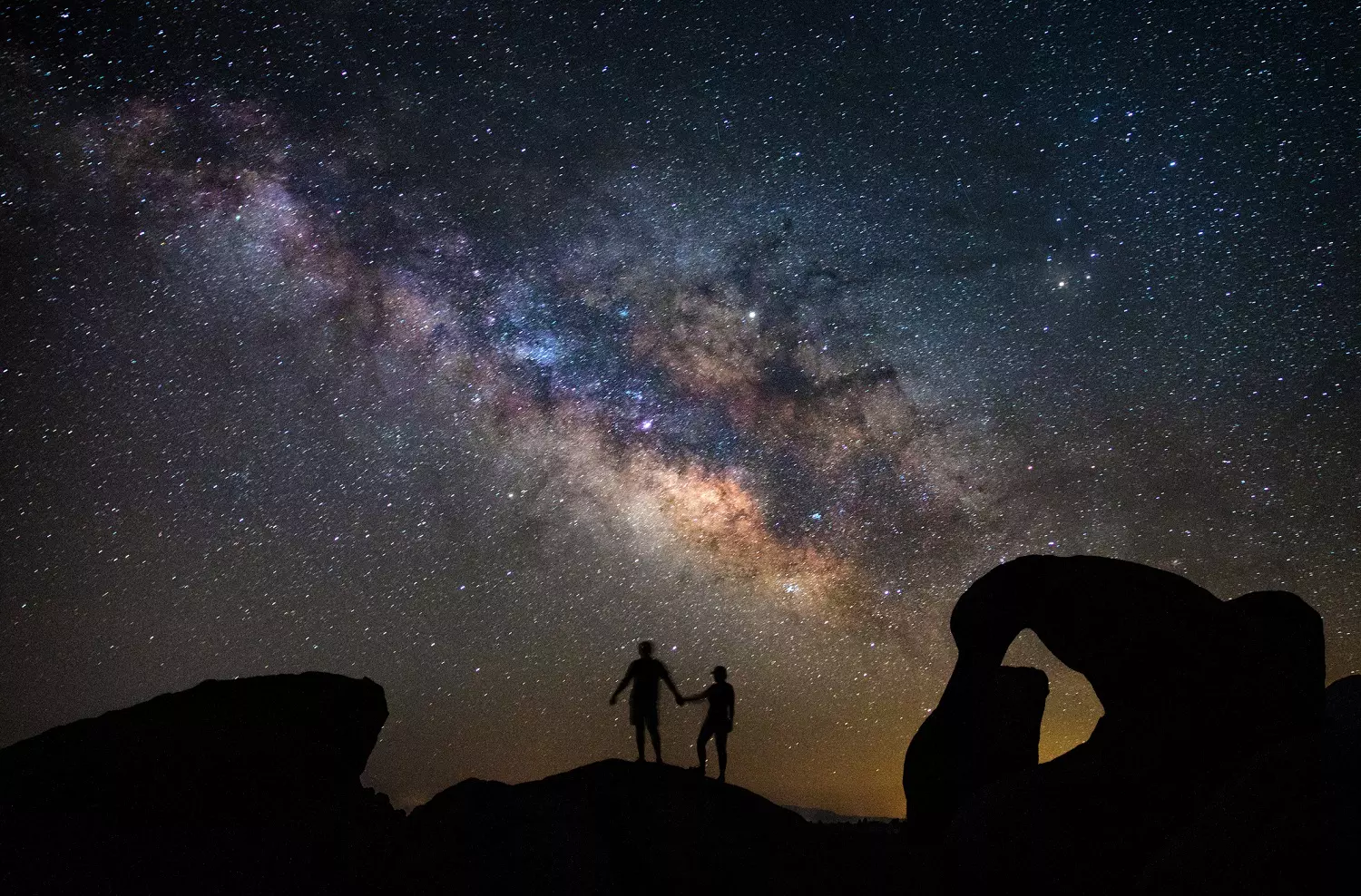
Mankind has been fascinated by the stars since the beginning of history. The oldest cultures we know of worshipped the sun and moon as if they were gods. In the ancient mindset, there is a close connection between stars and angels. They certainly didn’t have access to the kind of scientific instrumentation that allows us to recognize that there are far more stars than are visible to the naked eye, and that they are made of luminous gases.
But it is still a mistake to refer to ancient people as “pre-scientific.” While they did not have some of the beliefs and processes we have today, they still cared about the natural world and attempted to understand it. They did not “do science” the same way we do, but they still did it! For example:
Archeoastronomy
- The Great Pyramid in Egypt (along with the other two pyramids at Giza) is astronomically aligned with the constellation Orion.
- Stonehenge and other henges scattered across the globe. While there is still mystery around their purposes, they are recognized as consciously alligning with the stars of the solstices and equinoxes.
- Measuring the earth: While today many believe that the ancients thought the earth was flat up until the time of Christopher Columbus, the first experiment to successfully predict the earth’s circumference predates the time of Christ!
Danny Faulkner writes:
“A lunar eclipse obviously must happen simultaneously for everyone on earth, but it will be at different times at different locations. For instance, a lunar eclipse may start shortly after sunset in the eastern Mediterranean, such as in Greece. However, in the western Mediterranean, such as in Spain, the moon might already be in eclipse when the moon rose that night. This means that the lunar eclipse began before sunset/moonrise in Spain, but after sunset/moonrise in Greece. While communication was much slower in the ancient world than it is today, people did record and share their observations, so people in the ancient world were aware of this effect. This shows that the earth is curved in the east-west direction. If the earth is curved in both the north-south and east-west direction, the most likely shape of the earth is a sphere.”
Eratosthenes, a Greek mathematician, accurately estimated the Earth’s circumference around 240 B.C. He used a clever method involving the angles of shadows in two different locations, Syene (now Aswan) and Alexandria, both in Egypt, on the summer solstice. By measuring the angle of the shadow in Alexandria and knowing the distance between the two cities, he was able to calculate the Earth’s circumference with remarkable accuracy. His estimate was about 40,000 kilometers, which is very close to the modern measurement of approximately 40,075 kilometers.
There are about 60 verses in the Bible that speak specifically about astronomical ideas. For example:
- Canst thou bind the sweet influences of Pleiades, or loose the bands of Orion? Canst thou bring forth Mazzaroth in his season? or canst thou guide Arcturus with his sons? Knowest thou the ordinances of heaven? canst thou set the dominion thereof in the earth? (Job 38:31–33)
- When I consider thy heavens, the work of thy fingers, the moon and the stars, which thou hast ordained; What is man, that thou art mindful of him? and the son of man, that thou visitest him? (Psalm 8:3–4)
- The heavens declare the glory of God; and the firmament sheweth his handywork. (Psalm 19:1)
- Thus saith the LORD, which giveth the sun for a light by day, and the ordinances of the moon and of the stars for a light by night, which divideth the sea when the waves thereof roar; The LORD of hosts is his name: (Jeremiah 31:35)
- Seek him that maketh the seven stars and Orion, and turneth the shadow of death into the morning, and maketh the day dark with night: that calleth for the waters of the sea, and poureth them out upon the face of the earth: The LORD is his name: (Amos 5:8)
In other words, the Bible mentions astronomy a lot. This raises an important question that is still debated among scholars:

How closely does the Bible map to the real world?
We talked about this last week with the idea of “phenomenological language” — the biblical writers wrote what they saw, heard, and experienced. They were never attempting to “do” science. This means we sometimes get mixed results when trying to map the Bible to scientific models.
If you’ll remember, we landed on the fact that the Bible matters for history even though it’s not a science textbook. It may touch on things that matter for science from time to time, but it’s never trying to teach you science.
That’s the approach I take. There is much we can learn from the Bible about astronomy, but much more that we can’t!
We can, however, use it to form guidelines that help us think about modern science and astronomy. This is helpful because astronomy is one of the things people use to attack the Bible—especially a young-age creationist position like we assume in this class. The attack centers around two ideas: the Big Bang model and the “distant starlight problem.” We’ll talk about these next.