
 Eleanor Gillespie
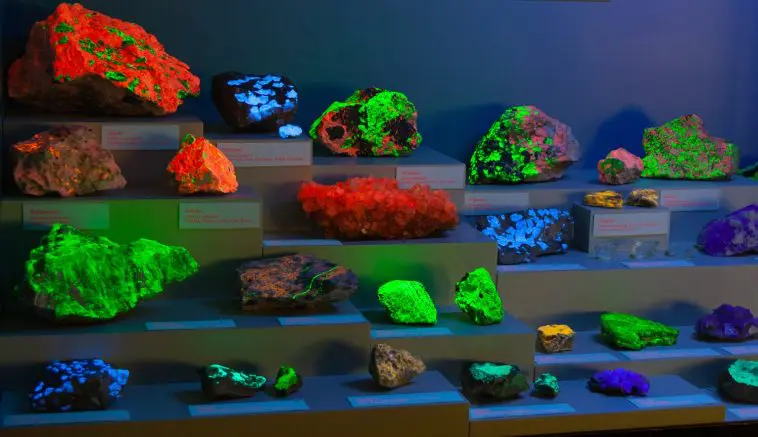
Fluorescence is a relatively uncommon phenomenon in the mineral world, with only 10–15% of all minerals fluorescing. It is one of those hidden beauties that can point us to the majesty of our Creator as he unexpectedly reveals himself to us.
Frederick W. Herschel first observed glowing minerals in 1845 when he discovered that quinine water would emit blue light under ultraviolet (UV) light. Just a few years later, in 1852, Sir George Gabriel Stokes coined the term “fluorescence” when he observed that fluorite emitted a red light when exposed to UV light.
What’s Going On
Light moves in waves of various lengths, which can be shown arranged in a narrow band on the electromagnetic spectrum. This spectrum ranges from long-wave and the lowest energy level to gamma waves, with the shortest wavelength and the highest energy level. As you can see on the diagram, ultraviolet waves are just higher in frequency and just shorter in wavelength than visible light:


ranging from longwave to gamma rays. Photo credit: Philip Ronan
Fluorescence occurs when objects, in this case, specific minerals, are subjected to the ultraviolet light. The molecules within these fluorescent minerals absorb the light energy, and electrons in the molecules become excited, or increase their energy level. See Diagram 2 below, which shows what is happening at the atomic level.

Looking at the atom on the left part of the diagram, the electron is in its original position before being excited by a UV light source. In the middle atom, notice that the electron has moved from the inner circle or the lowest energy level to the middle circle or a higher energy level because it has become excited by the light. In the atom on the right diagram, the electron’s orbit has decayed, returning to its original level, and has emitted excess light energy, causing the mineral to glow.
Fluorescent minerals will only glow or give off light while an ultraviolet light source is present to excite them. This is especially interesting because of their unexpected and vibrant colors. Without the UV light shining on them, these minerals look rather dull and uninteresting.
In addition, some fluorescent minerals will only glow under longwave or shortwave UV light, while others reflect different colors depending on the wavelength they are exposed to. Why?
The color of a fluorescent mineral is dependent upon specific activators or impurities found in the crystal structure.
- Impurities such as manganese in calcite can cause orange fluorescence, while uranium can cause green fluorescence.
- Oil droplets in fluorite can cause a yellow or pale blue fluorescence.
- A blue fluorescence in calcite can be caused by zinc and cobalt.
There are additional colors produced depending on the minerals and the types of impurities.
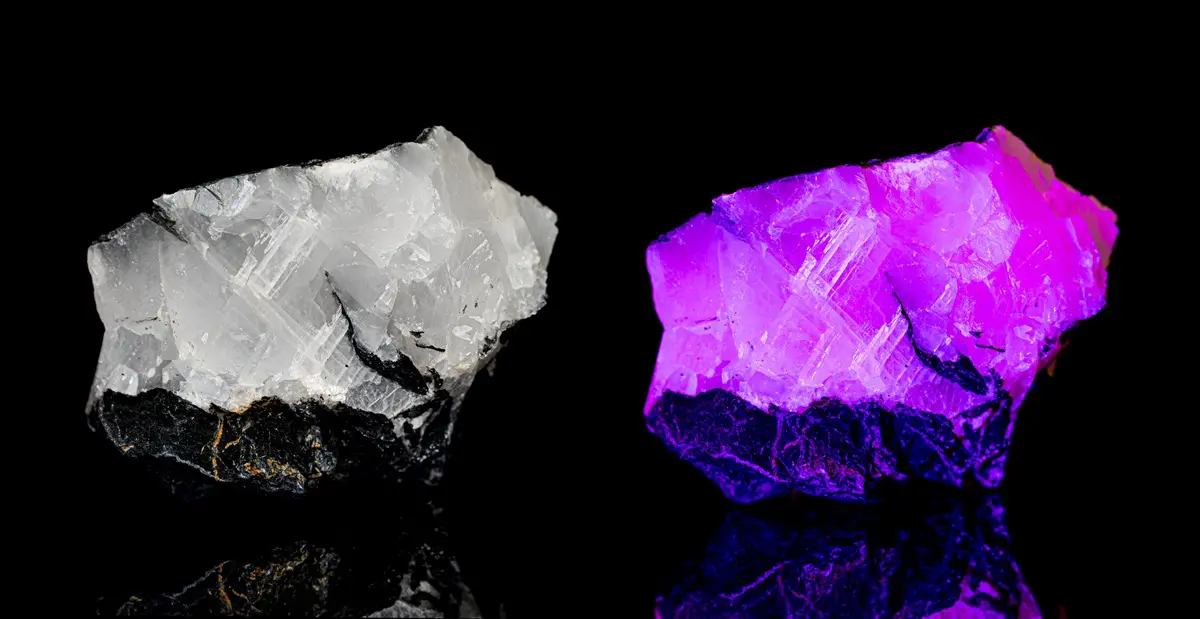
Probably the most common fluorescent mineral is calcite. Other common minerals include fluorite, aragonite, barite, chalcedony, corundum (rubies and sapphires), and sodalite (also known as yooperlite in the Upper Peninsula of Michigan). Some less common minerals include apatite, cerussite, opal, and hyalite.

Perhaps the most well-known location for collecting fluorescent minerals is Franklin, New Jersey, which has been called the “Fluorescent Mineral Capital of the World,” and some of its fluorescent minerals cannot be found elsewhere. Some of the most common minerals found there include willemite, calcite, clinohedrite, and esperite. Willemite fluoresces green under UV light, while calcite fluoresces yellow to orange-red. Clinohedrite fluoresces orange under UV light, and esperite fluoresces yellow under UV light. Franklinite, named for the region, does not fluoresce under ultraviolet light but remains black while surrounding minerals fluoresce. Franklinite was mined for its zinc content.
Other locations for collecting fluorescent minerals in the United States include the Purple Passion Mine northeast of Wickenburg, Arizona, St. Lawrence County in New York, and several locations in New Mexico.
How to Grow Your Fluorescent Mineral Collection
You can start by obtaining a good UV longwave light and shining it across the rocks you already have. It is best to do this in a dark location.
If you want to maximize your collection, you may want to begin collecting minerals from Franklin, New Jersey. These minerals are desirable because of the variety and brightness of their fluorescence. You can do this by visiting a gem and mineral show, shopping online, or, if possible, you can collect them yourself by visiting a place like the Franklin Mineral Museum in Franklin, New Jersey.
Other, less well-known locations to find fluorescent minerals include searching for “yooperlite” along the shores of the Upper Peninsula of Michigan. Obviously, the best time to search for fluorescent minerals is at night, especially after a winter storm, which can make it challenging.
Phosphorescence
Phosphorescence works in a similar manner to fluorescence, except that, while fluorescence is a short-lived excitation of the electron, phosphorescence is a long-lived excitation of the electron after the UV light source has been removed. Examples of potentially phosphorescent minerals are calcite, celestite, fluorite, and sphalerite.
Honoring our Creator
Fluorescence can remind us about Jesus and the reason He came. Jesus said,
“I have come as Light into the world, so that everyone who believes in Me will not remain in darkness.” (John 12:6)

The Bible tells us that Jesus “was the true light which, coming into the world, enlightens every man” (John 1:9). Until His light shines on us, we remain in darkness. But when His light shines on us, we see light.
For with You is the fountain of life. In Your light we see light. (Psalm 36:9)
Fluorescence can also remind us of the light that can shine from us.
“Let your light shine before men in such a way that they may see your good works, and glorify your Father who is in heaven: (Matthew 5:13).
Fluorescence is a hidden beauty that is revealed only under a special type of light. It is the same in our lives. Only after accepting Jesus as our Savior and Lord can His light transform us. We can become like “excited” rocks that cry out as Jesus walks about in Luke 19:40, praising God and pointing others to the majesty and wonders of the Lord.
Footnotes:
- Schneider, S. (2016). Collecting Fluorescent Minerals, Schiffer Publishing.
- Gillespie, Eleanor. “How to Get a Rock Excited – Fluorescence.” Nugget, vol. 24, no. 10, (10 March 2025), pp. 6-8.