 Jay Wile
[Originally published in 2012 as A Rorschach Test for Paleontologists]
The Cambrian Explosion causes headaches for evolutionists. And their desperate attempts to explain it don’t work at all.
A commenter on my blog tried to claim that the Ediacaran fossil assemblages offer an explanation for the Cambrian Explosion, but had he actually read the link that was provided, he would have known that they do not. Instead, the Ediacaran fossils cannot be connected in any reasonable way to the fossils found in the Cambrian.

To emphasize this, I quoted from N.S. Sharma’s book, Continuity and Evolution of Animals:1
Although the stratigraphic distribution of Ediacaran fossils is clear enough, their biological interpretation remains controversial, providing what amounts to a Rorschach test.
He continues on to explain that there are “several distinct body plans” among them, including radially symmetric fossils that are dissimilar from living fauna. Other fossils are made up of “tube-like units.” He continues:
It is genuinely difficult to map characters of Ediacaran fossils into the body plans of living invertebrates. Long viewed as the principal problem of interpreting Ediacaran assemblages, this difficulty increasingly appears to be their central point.
An online paper published by the journal Nature demonstrates that Sharma’s characterization of these fossils is right on the money.
The paper was written by Dr. Gregory J. Retallack, a professor in the department of geological sciences at the University of Oregon. He is an expert on fossil soils and has been published widely in the peer-reviewed scientific literature.
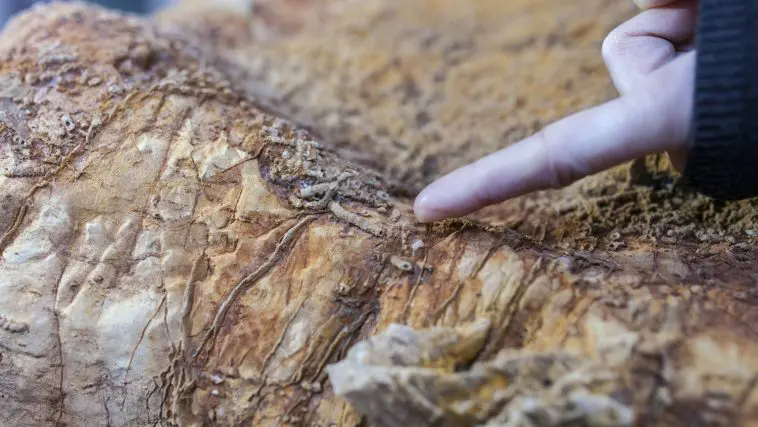
He is convinced that some of the Ediacaran “fossils” are not fossils at all. Instead, they are the result of non-biological processes at work in dry soil. Other Ediacaran fossils are fossils, but they are not fossils of marine animals. Instead, they are fossils of land-dwelling multicellular organisms like lichen or land-dwelling microbial colonies. In the article, he marshals several lines of evidence to support his view.

When speaking of the fossils that he thinks are real fossils, he says2
This new interpretation of some Ediacaran fossils as large sessile organisms of cool, dry soils, is compatible with observations that Ediacaran fossils were similar in appearance and preservation to lichens and other microbial colonies of biological soil crusts, rather than marine animals, or protists.
This is radically different from the traditional interpretation of Ediacaran fossils. According to standard evolutionary reasoning, multicellular organisms didn’t reach land until about 65 million years after the Ediacaran fossils were formed. In addition, the Ediacaran fossils have been interpreted to be the remains of marine animals for quite some time now.
Of course, most paleontologists disagree with Retallack’s conclusion. As Dr. James Gehling said in a commentary published along with the paper:3
If 60 years of published interpretations of the Ediacara biota have shown anything, it is that the Ediacara biota were a diverse array of organisms with remarkably consistent body plans found in distinct associations and most often preserved in place on fossil sea floors.
Gehling might be right. Retallack’s conclusions may be way off base. However, the very fact that he can present serious evidence that suggests at least some of the Ediacaran fossils are land-dwelling organisms makes it clear that they have little or no connection to the fossils in the Cambrian. Instead, as Sharma indicated, paleontologists see a variety of things in these fossils, and it isn’t clear which (if any) of those things is correct.
References
- N.S. Sharma, Continuity and Evolution of Animals, International Scientific Publishing Academy 2005, pp. 81-82.
- Gregory J. Retallack, “Ediacaran life on land,” Nature doi:10.1038/nature11777, 2012.
- Brian Switek, “Controversial claim puts life on land 65 million years early,” Nature doi:10.1038/nature.2012.12017, 2012.