 Creation Truth Foundation
[Originally published as Flooded Marine Reptile]
The Flood of Noah’s day was a devastating judgment on the sin and wickedness of the time. While most people focus on what the Lord did as He saved the eight people and animals on the Ark, at the same time, the Flood destroyed the earth and left behind some remarkable things.
Geological features worldwide demonstrate how plants and animals were buried in watery sediment. Many of the animal remains also show signs of drowning before their burial.

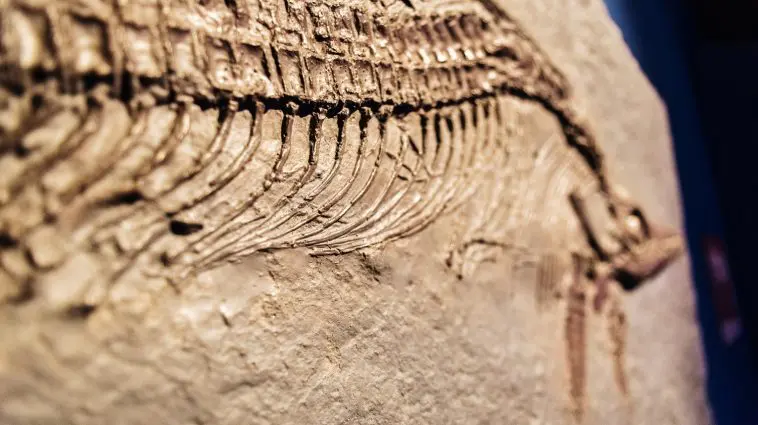
One particular reptile that shows this is the Ichthyosaurus. From what we know, it’s clear that water was her home environment for everything in her life, even giving birth to live young.
This well-designed creature may even help us trust the Word of God when it comes to the history of the Flood.
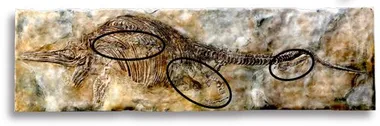
In our Mobile Museum of Earth History, we exhibit a research-quality replica of an Ichthyosaur called Stenopterygius quadriscissus. She was found in the rocks at Holzmaden, Germany and is one of hundreds of such fossils that have been found in the area.
The reason we can so confidently state this fossil is a “she” is because she was buried while pregnant. Buried with her are the remains of three babies: one under her tail, one in or near the birth canal, and one still inside of her.
Our fossil was buried in situ, which means the fossil was buried whole in the same rock matrix it is found in today. So, the position of both momma and babies shows how they were buried rather than the best guess of a modern paleontologist reconstructing things. This is important because it shows how rapidly this water-living creature was overwhelmed with sediment and buried, locking this scene into the fossil record.
The Array of Quickly Buried Creatures
All across the glob, the Flood trapped organisms in different life positions. Sometimes the fossils show the creatures were buried while:

- eating,
- hunting,
- sleeping,
- swimming,
- nesting,
- or resisting drowning.
When it comes to Ichthyosaur fossils, we have found a significant number of females that seem to be pregnant across at least four continents. It is possible that Ichthyosaurs had a certain time of year they mated and gave birth to young, much like sea turtles today, which nest from late spring to late fall depending on the region around the world.
So it should come as no surprise that we find pregnant ichthyosaurs all around the world as the Flood lasted an entire year. It would have buried the females that were pregnant near their location of habitat.
Evolutionists maintain that ichthyosaurs lived from 90 to 250 million years ago and each of the mothers found in the fossil record just happened to die while giving birth. This is difficult to support in a millions magnitude time scale. This would mean every time a disaster happened — millions of years apart — the right conditions existed to quickly bury ichthyosaurs that just so happened to be pregnant.
It just might take some faith to trust such an unlikely event would happen over and over again through eons of time. Or, you can have faith that the Word of God’s history is correct with a judgment of man’s sin bringing global devastation through the Flood during Noah’s 600th year of life.
The Word of God is trustworthy, with even the fossil record showing us glimpses of historical evidence in support of our faith. I’m so thankful we don’t need blind faith to trust our salvation! Blessings.