
 Jay Wile
[Originally published in 2013 as Why (and How) Your Skin Wrinkles Underwater]
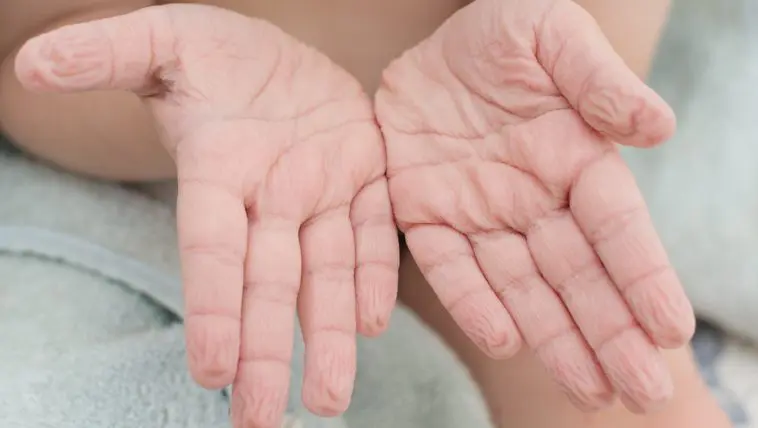
Almost everyone has experienced it. When you have been soaking in the bathtub, swimming, or just washing dishes for a long time, the skin on your fingers (and toes) wrinkles. From a scientific point of view, there are at least two questions to consider:
- How does this happen?
- Why does this happen?
Most textbooks explain (often incorrectly) the how, but I haven’t found any that explain the why. It seems that over the years, scientists have been studying this, and in the end, they have mostly answered both questions.

Let’s start with the “how.” A lot of textbooks and websites incorrectly explain this part. They say that it is the result of your skin absorbing water and swelling. It turns out that’s not true at all. More than 70 years ago, scientists showed that if certain nerves to the hand are damaged, its skin will not wrinkle, no matter how long it stays underwater.1 Over the years, other scientists have investigated water-induced wrinkling, and it seems to be the result of a process initiated by the nervous system.
Your skin is made of two layers: the epidermis (the layer you see) and the dermis (the layer underneath that contains blood vessels). When your hands and/or feet have been underwater for a long time, your nervous system tells the blood vessels in your dermis to constrict. This reduces the volume of the dermis, which in turn reduces the tension with which the epidermis is stretched. As a result, the epidermis “relaxes,” forming wrinkles.2
This answer is interesting by itself, because I have long taught the incorrect explanation for how your skin wrinkles underwater. I am glad that I learned I was wrong on the point, and I will now start teaching the correct explanation. More than this, the “why” question is particularly intriguing, and a couple of recent studies have provided a good answer for that question as well.
Some years ago, some scientists from Boise, Idaho studied the water-induced wrinkling process in depth and showed that the wrinkles look a lot like the treads on a tire or shoe. Such treads allow the tire (or shoe) to grip a wet road (or floor) better, because the water that is on the surface is pushed into the treads, allowing the rest of the tire (or shoe) to have direct contact with the surface. They also point out:3
Wet-induced wrinkles may, in fact, be substantially superior to ‘rain treads’ on shoes, which maintain a tread even when under compression and thus have a surface area of contact that is reduced. Wet-induced wrinkle treads, on the other hand, are pliable, and the act of pressing a finger tip down on a wet surface ‘squeezes’ the fluid out from under the finger through the channels, and upon completion of this single pulsatile flow the entire finger’s skin contacts the surface.
While their study was very good, it didn’t provide any direct evidence that the wrinkles improved grip. It only showed the wrinkles have the properties that should allow them to improve grip. Now a different study has provided direct evidence for their conclusion.
A group of scientists from the UK tested how well people handle objects underwater. They constructed a vessel that was filled with water and had a barrier in the middle. The barrier had a small hole in it. Subjects were asked to put their hands underwater, one on each side of the barrier. Then, they had to pick up objects from an underwater bin with one hand and push them through the hole in the barrier to their other hand. Finally, they had to drop the objects through a hole into a box. They found that if the subjects had been soaking their hands in water so that they already had wrinkles, they completed the task (on average) about 12% faster.4

In order to make sure this was an effect similar to what is provided by the treads on a tire or shoe, the scientists repeated the experiment without the water. As a result, the objects were all dry. In that version of the experiment, subjects completed the task in roughly the same amount of time, regardless of whether or not their hands were water-wrinkled.
In the end, then, it seems that the wrinkles you get on your hands and feet act like the treads on tires or shoes. They improve the grip you experience when you are handling wet things. In addition, this seems to be a designed response, since it is initiated by the nervous system and is not the result of some passive effect such as the absorption of water. The more we study nature, the more we see how intricately it has been designed!
References
- Lewis, T and Pickering, GW, “Circulatory changes in fingers in some diseases of the nervous system, with special reference to digital atrophy of peripheral nerve lesions,” Clinical Science 2:149, 1936
- Wilder-Smith, EP and Chow, A, “Water-immersion wrinkling is due to vasoconstriction,” Muscle & Nerve 27:307–311, 2003
- Mark Changizi, Romann Weber, Ritesh Kotecha, and Joseph Palazzo, “Are Wet-Induced Wrinkled Fingers Primate Rain Treads?” Brain, Behavior, and Evolution 77(4):286-90, 2011
- Kyriacos Kareklas, Daniel Nettle, and Tom V. Smulders, “Water-induced finger wrinkles improve handling of wet objects,” Biology Letters doi:10.1098/rsbl.2012.0999, 2013