 Emory Moynagh
[Editor’s note: this article is mathematically dense but short, and it demonstrates how the same information is handled by various researchers with different worldview biases. The conclusions are easy enough for the average person to follow the line of reasoning. They are set off by headers for those who wish to skim. Originally published as mtDNA in Vertebrate Kinds]
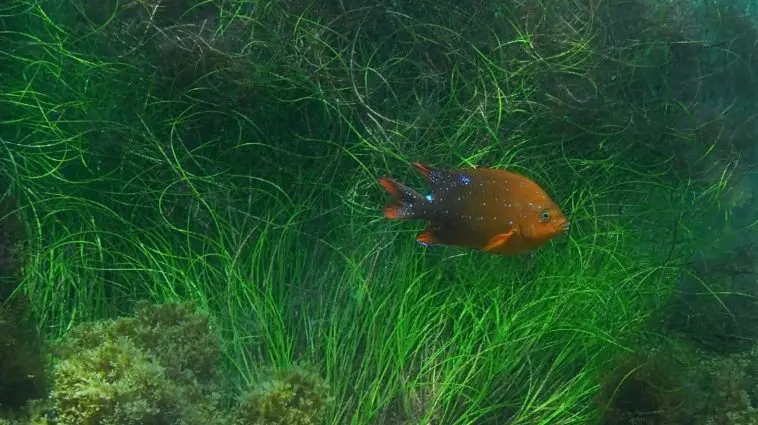
Instead of working with one genus in this article, we will be working with an entire family. Pomacentridae is a family of coral reef fish well known in popular culture. Think clownfish, chromis, sergeant majors, and damselfish. Twenty different mtDNA sequences were aligned in MEGA using Muscle.
Twelve of those were from the clownfish from genus Amphiprion and Premnas. This disparity is due to a lack of full mtDNA sequences from other genera in the NCBI database. A second run was done with only two membera of Amphiprion and one of Premnas. Both results are reported.

Results 1:
After alignment, the number of single nucleotide variants was derived using MEGA. Total number of SNVs was 9055. This number was substituted into Dr. Jeanson’s equation as shown below.
# of SNVs/6000/2=mutation rate
9055/6000/2-=mutation rate
9055/6000=1.509
1.509/2=.7546m/y
These numbers work out to about three-quarters of a mutation per year.
I was unable to find a study that directly determined the mutation rates in Pomacentridae. However, I did find one that estimated the cyt b gene’s mutation rate, as well as the control region’s (CR) mutation rate. So I averaged the two to determine an estimated rate of mtDNA mutation in Pomacentridae.

.068+.028=.096
.096/2=4.8% per million years.
There are 18,752 possible positions in the alignment. Therefore
18,752x.048=900 mutations per million years.
900/1,000,000=.0009mutations per year.
Here, I have derived a much higher rate using Dr. Jeanson’s equation. However, this rate is not measured, it is an average of assumed numbers. So I do not put too much stock in this rate. We will use it only because nothing else exists.
Based on this admittedly inexact rate, how many mutations would evolution expect in the 50 million years since Pomacentridae appeared?
.0009 m/y X 50,000,000 my= 45,004.8 mutations.

For reference, the largest mtDNA genome we are dealing with is under 19,000 nucleotides. The evolutionist prediction would be for more than double that number of mutations. Mutations are missing.
Results 2:
For the second alignment, most of the Amphiprion and Premnas species were removed. This brought the alignment down to eleven sequences. As expected, there were fewer variable sites. 8831 SNVs existed in the alignment of 18,558 bases. The results were calculated as above.
# of SNVs/6000/2= mutation rate
8831/6000/2=0.735 mutations per year.
Note that, despite removing the members of Amphiprion and Premnas, the rate calculated did not change very much. That is good, because it means the original did not have a large sampling bias.
Since the original evolutionary analysis used the original alignment’s number of bases, we need to quickly recalculate it as well.
18,558 x .048=890.784 mutations per million years. Rounding puts us at 891.
891/1,000,000=0.000891 mutations per year
Recalculating the number of mutations that would take place since Pomacentridae supposedly evolved, we get:
.000891×50,000,000= 44,550 mutations in 50 million years.
Again, the mtDNA is less than 19,000 bases long.
What can we make of these results?
Well, the evolutionist severely lack mutations. The mtDNA data is a brutal gut punch. The mutations they would expect are not there.
For the creationist, however, what can we take from this?
Using MEGA, I built phylogenetic trees for the first result set. While I do not accept phylogenetics as a whole, it can be useful to visualize similarities and differences.
While there is a strong grouping among Amphiprion and Premnas, none of the rest of the genera group together. This is very intriguing. It hints that, possibly, there is a discontinuity between the clownfishes of Amphiprion and Premnas and the rest of the Damselfishes.
The Takeaway is Two-Fold:
We have run an experiment and tested the possibility that mtDNA can be used to help determine vertebrate kinds, and we have demonstrated that even using their own numbers, evolutionists predict far too many mutations compared to what we observe.
Papers used
https://www.sciencedirect.com/science/article/abs/pii/S1055790308002029
Click to access Fr%C3%A9d%C3%A9rich%20et%20al%202013%20(Am%20Nat).pdf