
 Chad Arment
[Originally published as the first section of The Mystery of the Maltese Viper: The Herpetological Enigma Behind the Apostle Paul’s Snakebite]
One of the biggest obstacles to understanding the Bible is not recognizing context. While Christians (hopefully) know that we use a historical-grammatical hermeneutic — attempting to discern the biblical authors’ intended meaning by considering the context of the passage in question — application varies, and we may not fully recognize the many ‘lenses’ of contextual layers that influence our understanding of the original writings.
Brad Gray notes six of the most basic lenses of context that we should consider as we read the Bible: cultural, historical, literary, linguistic, visual, and geographical.1 By understanding the context of Scripture, we find that many of the so-called ‘problems’ of the Bible are simply misinterpretation or fallacious.

For creationists trying to understand why the natural world is as it is, I think it’s fair to contend that there is a lens of science. Obviously, this doesn’t mean using secular assumptions as a starting point, but rather recognizing the reality of the natural world as God’s creation. We aren’t investigating fairy tales, so we may need to closely examine the scientific issues that arise through zoology, botany, geology, astronomy, physics.
One zoological puzzle emerges with the following passage during the Apostle Paul’s sea voyage from Israel to Rome. While gathering firewood, Paul inadvertently picks up a snake:
After we were brought safely through, we then learned that the island was called [Μελίτη]. The native people showed us unusual kindness, for they kindled a fire and welcomed us all, because it had begun to rain and was cold. When Paul had gathered a bundle of sticks and put them on the fire, a viper came out because of the heat and fastened on his hand. When the native people saw the creature hanging from his hand, they said to one another, “No doubt this man is a murderer. Though he has escaped from the sea, Justice has not allowed him to live.” He, however, shook off the creature into the fire and suffered no harm. They were waiting for him to swell up or suddenly fall down dead. But when they had waited a long time and saw no misfortune come to him, they changed their minds and said that he was a god. (Acts 28: 1–6)
This short episode has layer upon layer of context that can be investigated. The main issue for us is the identity of the ‘viper.’ We know that there are no true vipers (Family Viperidae) native to the island of Malta. Does that mean the Bible is inaccurate? Do we have to fall back on just-so stories to try and make the Biblical narrative fit the facts? We’ll explore several of the issues here, including the identity of the snake and why exactly this episode is included in Acts, but first we need to step back and look through a geographic lens.
Malta is the traditional site for Paul’s shipwreck, and this is likely true despite various alternatives offered over the years. So, the question becomes: what type of venomous snakes would be in the environment of the island during the First Century?
Zoological Context: The Snakes of Malta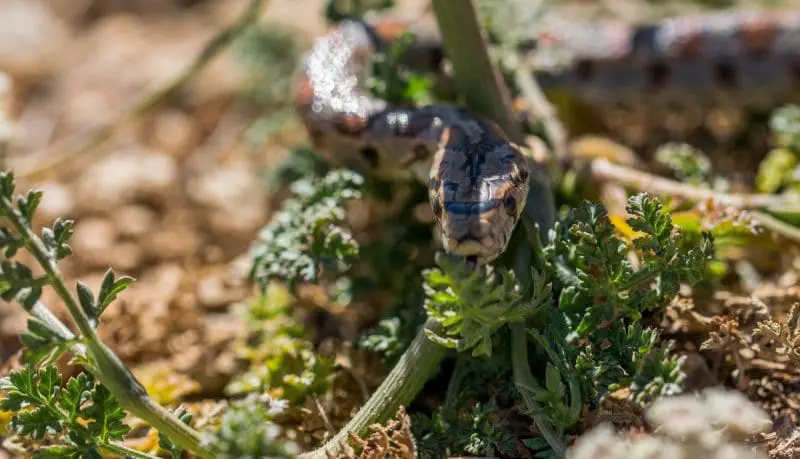
If the island of Malta was in fact Paul’s shipwreck site, what snakes would have been on the island? While biblical commentaries tend to be a little vague on this subject, it turns out that there is a significant body of scientific literature studying the herpetofauna of Malta.
Despott initially noted two species of snakes, the western (or green) whip snake (Hierophis viridiflavus) and the leopard snake (Zamenis situla), along with five native lizard species and one frog.2 Boulenger in his Snakes of Europe suggested that the western whip snake may have been Paul’s ‘viper,’ due to its ‘viciousness.’3 (Whip snakes tend to bite first, and ask questions later.)

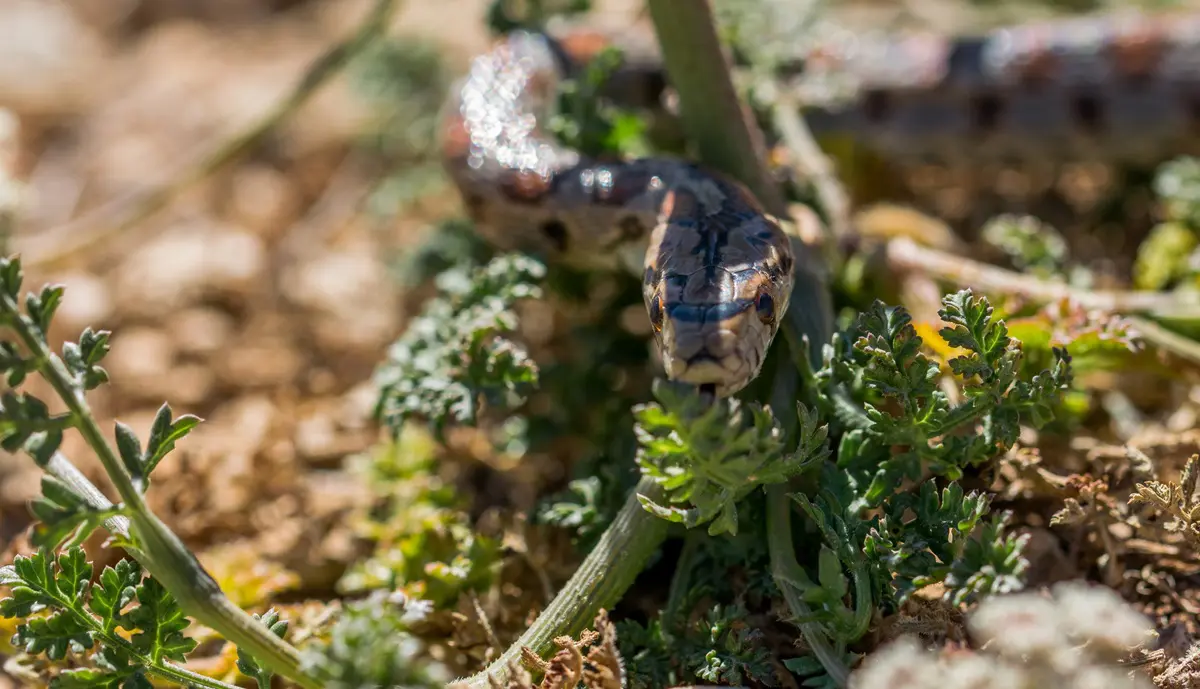
The leopard snake has also been suggested as the culprit, due to superficial similarities in morphology to European vipers.4 Despott also noted that a cat snake (Telescopus fallax) had been reported on Malta, but with only that report he was uncertain about adding it to the fauna list. Lanza described the finding of the Algerian whip snake (Hemorrhois algirus) in 1927, with additional specimens found in 1928, 1953, and 1954, all discovered in the Floriana area.5 These are the only four snake species known from Malta, and are all in the Family Colubridae.
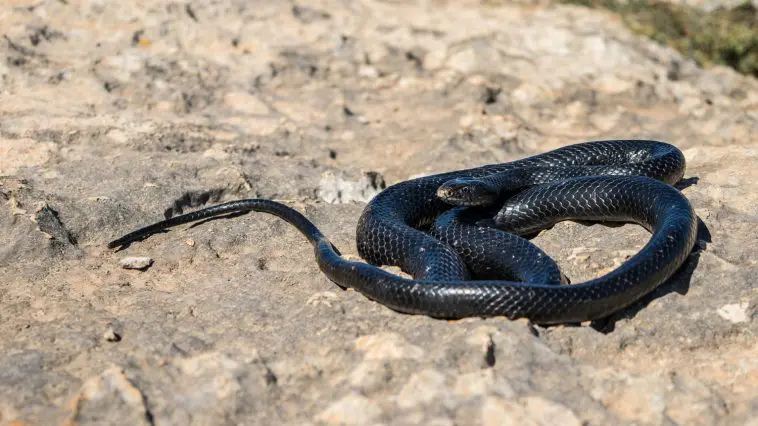
Schembri noted that the Maltese call the western whip snake (which in Malta is almost completely black), ‘Serp Iswed.’6 It is the commonest species, found throughout the Maltese Islands. The leopard snake is also found on all three islands, and is called ‘Lifgha.’
Lanfranco noted that ‘Lifgha’ is an Arabic word that just means “snake.”7 The cat snake and the Algerian whip snake are simply called “Serp,” being uncommon and only found on the Island of Malta. Schembri noted that while the latter two species being reported mostly from northeastern Malta conforms to the recent introduction theory, “since these snakes have retiring habits, and may easily be confused with other species, especially if only a fleeting glimpse is caught of the animal, they may be far more widespread than is thought. The Cat Snake may well be indigenous.” The whip snakes and leopard snake hunt during the day or at dusk, while the cat snake is nocturnal.
While Maltese reptile fossils don’t include snakes, Savona-Ventura noted that connections during the Pleistocene “resulted in a number of . . . species which have a Maltese-Balcan-Asiatic distribution,” and pointed out that that would also describe the cat snake’s distribution.8 The leopard snake also has an eastern Mediterranean affinity.
Snakes appear to have healthy populations in the Maltese Islands. Looking at photographed and documented snakes in the Maltese Islands on the citizen science website iNaturalist, there are currently 16 observations between 2012 and 2021, with Hierophis viridiflavus, Telescopus fallax, and Zamenis situla all being found. (Hierophis was by far the most commonly seen, being an active and diurnal snake, but Telescopus was found in four separate locations on northwestern Malta.)
Could the snake have been a one-off introduction? Snakes and other reptiles sometimes are inadvertently transported and introduced to new locations. But Paul was gathering firewood, suggesting sticks from local brush. It is too much of a coincidence for an out-of-place snake to suddenly appear at the scene.
References
- Gray, B. 2019. The #1 Mistake Most Everyone Makes Reading the Bible. 2nd edition. ebook. Spring Hill, TN: Walking the Text.
- Despott, G. 1915. “The reptiles of the Maltese Islands.” The Zoologist 19(891): 321-327.
- Boulenger, G. A. 1913. The Snakes of Europe. London: Methusen.
- Savona-Ventura, C. 1983. Snakebites. Medi-Scope 3: 6-8.
- Lanza, B. 1973. “Gli anfibi e i rettili delle isole circumsiciliane.” Biogeografia 3: 755-804.
- Schembri, P. J. 1984. “Maltese snakes.” Civilization 13: 350-351.
- Lanfranco, G. 1977. “Some fallacies and misconceptions in the Maltese Islands.” Hyphen 1(1): 34-39.
- Savona-Ventura, C. 1984. “The fossil herpetofauna of the Maltese Islands: A review.” Naturalista Sicil. S. IV 8(3-4): 93-106.