 David Rives
[Excerpted from Rising Continents, Ancient Clues, and the Limits of Science]
Today, we’re talking about some exciting archeological news that verifies a small detail in the biblical account of the Exodus. But before we do, let’s look at why this find is a big deal.
The story of Moses and the Exodus of God’s people from Egypt to the Promised Land is doubtless one of the most celebrated biblical events. It has captured the imagination of the storytellers of history and produced extraordinary expressions of art for millennia.

Take, for example, the Dura Europass fresco, preserved in the National Museum in Damascus. This incredible work of art is one of the earliest known painted biblical scenes in a synagogue, dating to 244 A.D. Jumping forward, the 20th Century gave us the 1956 epic movie with Charlton Heston, The Ten Commandments., and in 1997, Steven Spielberg directed the Prince of Egypt.
But our fascination isn’t limited to the arts. Did you know that the Exodus event is the most frequently recalled historical event in all of Scripture? In many ways, it’s also the theological spine of the Old Testament narrative. Every major biblical theme, whether it’s salvation, or Covenant, Law, worship, promise, or land, is fixed upon it. And like everything else in the Bible, its true power is attached to the reality that it was a real event in history.
Theologian John Curtis says that to deny the history of the Exodus is to tear out the central pillar of the Old Testament. The Exodus is the gospel of the Old Testament, as it presents redemption by blood and by God’s power.
Here’s how evangelical scholar Gleason Archer puts it:
The historical trustworthiness of the Exodus is the lynchpin for the whole Old Testament revelation. If the Exodus were not a real deliverance from a real Egypt, then the covenant at Sinai becomes a fiction and the entire legal and prophetic structure built upon it collapses.
This isn’t just a good story; it’s a historical fact.
Being so pivotal, of course, there have been a barrage of attacks on the historicity of the Exodus, especially in the last 200 years.

Here’s a sampling of some statements that are made by scholars.
“The actual evidence concerning the Exodus resembles the evidence for the unicorn, who the Bible tells us that Israelites sojourn in Egypt. And yet archeology and texts from Egypt are silent.” ~Baruch Halpern of Pennsylvania State University
“Before they settled in the hill country of Canaan, where did the earliest Israelites come from and what was the nature of their society? The Bible is very clear. …Much of the scholarship of the last part of the 20th century, however, has reached a far different conclusion. One might almost describe it as diametrically opposed to the Biblical account.” ~ Biblical Archaeology Review
Now these claims can be easily dismantled by a simple look at how historically accurate the biblical text is. And my friend and colleague, filmmaker Tim Mahoney, has done great work when it comes to the Patterns of Evidence series of documentaries charting the Exodus.
Tell el-Kharouba
The October 2025 release of information regarding the discovery of the fortress of Tel Karaba supports a small footnote in the biblical story. Why does this matter? Because this is obviously not the first proof of the Exodus, and it certainly won’t be the last. But when a small footnote proves to be true, it adds support to our confidence in the history of the Bible.
God bakes these types of verification points into the Bible, and he is pleased to allow archeology to evidence his testimony as true again and again.
Here’s the text in Exodus 13:17–18:
And it came to pass, when Pharaoh had let the people go, that God led them not through the way of the land of the Philistines, although that was near. For God said, less peradventure the people repent when they see war, and they return to Egypt. But God led the people about through the way of the wilderness of the Red sea. And the children of Israel went up, harnessed out of the land of Egypt.
Advertisement Below:
The implication in this text is that the way to the land of the Philistines, even though it was convenient, was heavily fortified and would have led to war, which the people wouldn’t have been prepared for.
Well, this fortress gives us an example of what God was talking about.
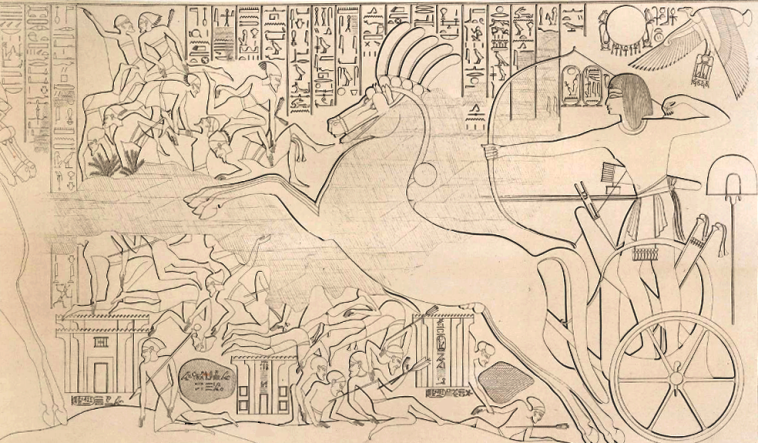
On October 11th, 2025, the Ministry of Tourism and Antiquities announced the discovery of a massive New Kingdom outpost called Tell el-Kharouba in the Sinai. This find spans several acres, making it one of the largest such structures found in Egypt and dates back to around 1506–1493 BC.
The fortress was positioned along the strategic Way of Horus, the ancient coastal route linking Egypt to Canaan, and served as a mostly self-sustaining garrison for up to 500 soldiers.
Experts like James Hoff Meyer from Trinity International University note that Tell el-Kharouba fits the kind of scale and geography that makes sense of God’s determination to have the people avoid this shorter road through the Philistine country, with its threat of possible recapture by Egyptian fortress forces.
We can wonder why God would lead the Israelites through the wilderness. Why lead them in a way that left them trapped for the Egyptians to overtake them? Well, he didn’t lead his people through Egypt’s gates, but through the wilderness. And on that impossible path, that’s where he parted the sea.
Every new discovery, like Tell el-Kharouba, reminds us that the Bible is rooted in real places. It’s rooted in real history, and real care and love provided by our Creator.
You know, God was pleased to humble Pharaoh, and I have to think that he laughs at those who builds empires of historical facts that they believe disprove what God has done in the past. Because the truth has a way of coming out, proving every jot and every tittle of God’s history.
Pharaohs, they come and go. Empires rise and fall. But the word of the Lord endures forever. I’m David Rives, and this is the Genesis Science Report.
For more information on Tell el-Kharouba see this article from the Armstrong Institute of Biblical Archaeology.