
 Dr. Tas Walker
[Originally published in 2012 as Time Traveller’s Guide—The Nebular Hypothesis]
Travelling back through time with Dr Richard Smith’s imaginary time machine on the ABC program Australia: The Time Traveller’s Guide, we reach his discussion of the nebular hypothesis at about 7 min.
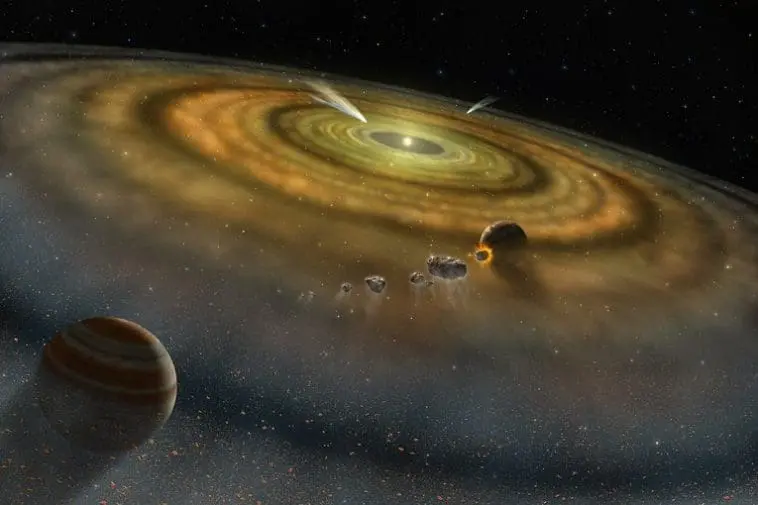
This hypothesis was first proposed by the French mathematician, astronomer, and atheist Pierre-Simon Laplace to explain how our solar system came into existence by natural processes. The idea is that the sun and the planets condensed from a swirling cloud of dust and gas, said to have occurred some 4.5 billion years ago.
The video is dramatic and persuasive, with glowing rocks and dust tumbling and colliding in space. The theatrical commentary speaks of
“Every fragment locked in gravitational mortal combat with every other lump of rock, metal, ice and dust in orbit.”
Although this is portrayed as a factual documentary, it is clearly an imaginative, speculative just-so story. The video never mentions that the nebular hypothesis does not work.
Jonathan Sarfati summarises some of the insuperable problems with the hypothesis and concludes:
Although the nebular hypothesis is accepted uncritically by many evolutionists, there are severe problems with forming both the sun and the planets from a collapsing cloud.
Secular scientists admit that the naturalistic formation of planets is exceedingly difficult.
At the 7 min 30 second mark in the video, we see glowing red chunks of rock orbiting in space and crashing together. But it’s cold in space. The chunks from which the planets formed would have been cold and black. Only after the earth’s formation, when the iron core differentiated, did the planet turn into a molten blob — according to the story.
But that’s artistic licence. Black rocks in black space would not make an exciting video.
None of the problems with the numerous models for planet formation are mentioned. None of the scientific issues are hinted at. None of the unanswered questions are touched on. If you relied on the video, you would think everything was completely settled, as if Richard Smith had watched the events all the way through.
But the science is far from settled. Indeed, the difficulties continue to grow and accumulate. There are problems, surprises, ad hoc adjustments, and speculations for every planet. One good video that deals with each of the planets, explaining the problems it presents for the naturalistic worldview, is presented by Spike Psarris: Our Created Solar System. The evidence supports the biblical account that our solar system is created and young.