
 Doug Velting
[Excerpted from the book, God’s Amazing Animals]
God created the Muskox with the ability to live in the cold North American Arctic tundra, where few other animals can survive.
The tundra is a place where winter temperatures drop to -50 degrees Fahrenheit, and food can be scarce. This is the home of the Muskox.

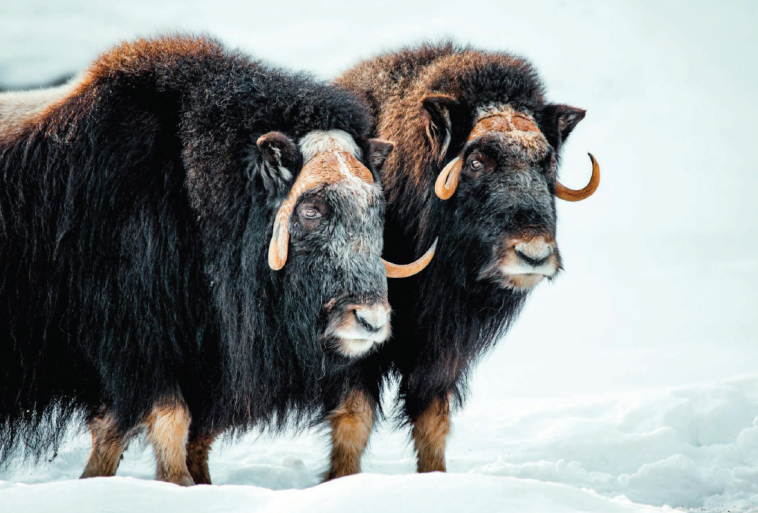
Muskox stand 4 to 5 feet high at the shoulders and 6 feet long. The males are larger than the females, weighing about 628 lbs. Their large heads and thick winter coats give them a larger appearance than they actually are. Both males and females have long curved horns that start at the center of their head, sweep down by the cheeks, and end in a flip. They can run up to 37 mph.
The Arctic wolf is the main predator of the Muskox, but God has given this Arctic animal excellent defense. When they see a pack of wolves coming, the Muskox quickly form a circle with calves in the center and the adults facing outwards with their horns as protection. It would take a courageous wolf pack to try to get past all those horns.
What makes the Muskox so amazing is the way God has designed it to survive in the harsh conditions of the North American Arctic. This mammal of the north is heterothermic, which means that they can turn off a portion of the heat in some parts of its body, like their legs. Having their lower limbs at a cooler temperature helps reduce the loss of body heat in that area.
Any mammal living in a freezing environment has to have a warm fur coat. The only skin that is exposed to the cold is the tip of its nose, and everywhere else on a Muskox is covered with the thickest, warmest fur in the animal kingdom. Long guard hairs reach the ground in winter, and under these is a silky, fine underwool that is eight times warmer than sheep’s wool.
Muskoxen feed on grasses, sedges, lichens, mosses, and Arctic willow. During the short Arctic summer, they eat a lot of grasses and perennial flowering plants to build up a layer of fat. When the long winter arrives, their grazing is limited to windswept hilltops where snow does not accumulate. The females give birth to one calf every other spring, from April to June, when warmer temperatures arrive. The calves are ready to walk and nurse hours after birth.
God has created the Muskox with the ability to live in the cold North American Arctic tundra.
For thou art great, and doest wondrous things; thou art God alone. (Psalms 86:10)
Advertisement Below: