 Bryan Melugin
[Originally published as a section of Thursday Night Nachos: Defining Evolution to Debunk Darwin: Defining Evolution 6: Creating New Genes]
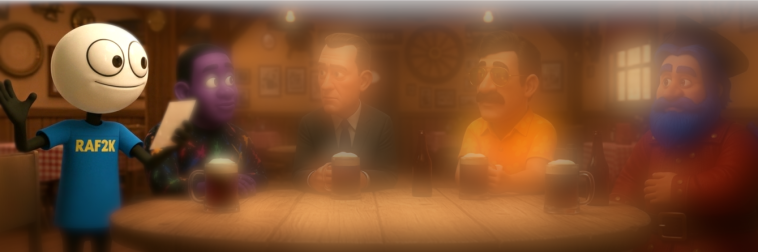
Every Thursday I gather for nachos with my friends: Carl, Tom, Blue Beard, and Bill. As a young-earth creationist who rejects Darwinian evolution on both scriptural and scientific grounds, I frequently have people coming to tell me how dumb I am for rejecting evolution which they insist is a fact of science. Carl is one such person.
But when asked to define what they mean by evolution, these people (including Carl) seem to have no idea what the word means, and often get angry at me for asking them to define it. To help out everyone in the Western world, I have created what might be the world’s first useful definition for “Evolution.” It goes like this: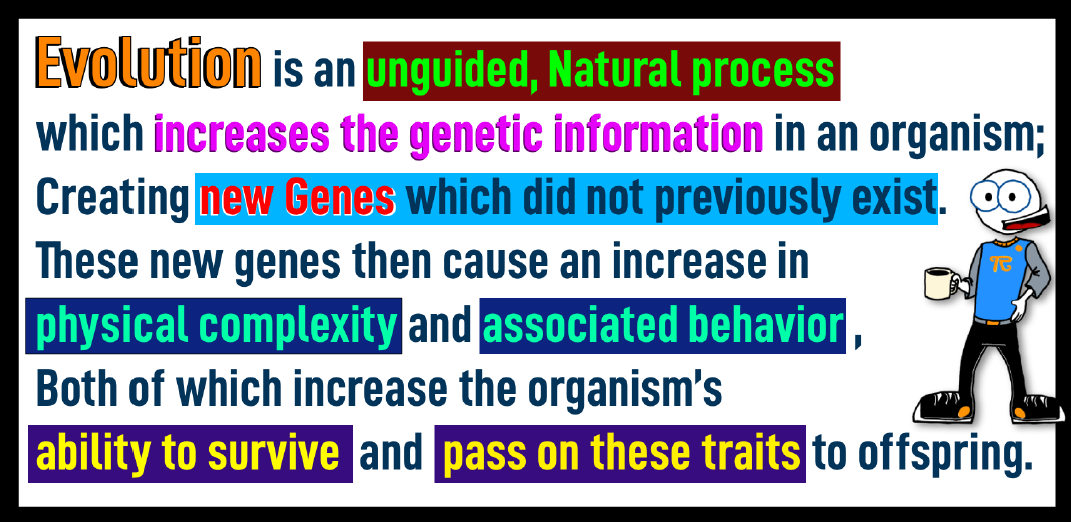
On this particular night, we would discuss why this definition says “which increases the genetic information in an organism; creating new genes which did not previously exist.”
While my friends enjoyed their rootbeer, I took the opportunity to remind them of the conversation as it stood per last week’s shallow dive into my wonderful and groundbreaking definition.
“To begin with, we must remember the story evolution intends to tell. It begins with bacteria (glossing over how we got something as complex and info-rich as a self-replicating bacteria) and the bacteria population somehow gained the genes to become worms, and the worm population somehow gained the genes to become fish, and the fish population somehow gained the genes to become lizards, which became rodents, which became primates which became bloggers, one of whom became a Rent-A-Friend.”
“At every step along the way,” I continued, “you will see the need for new genetic information.”
“Do we?” asked Carl. “I don’t know about that. Why does there need to be new genetic information in every step?”
“This is why I reminded us of the tree,” I said, showing my illustration of the evolutionary Tree of Life.
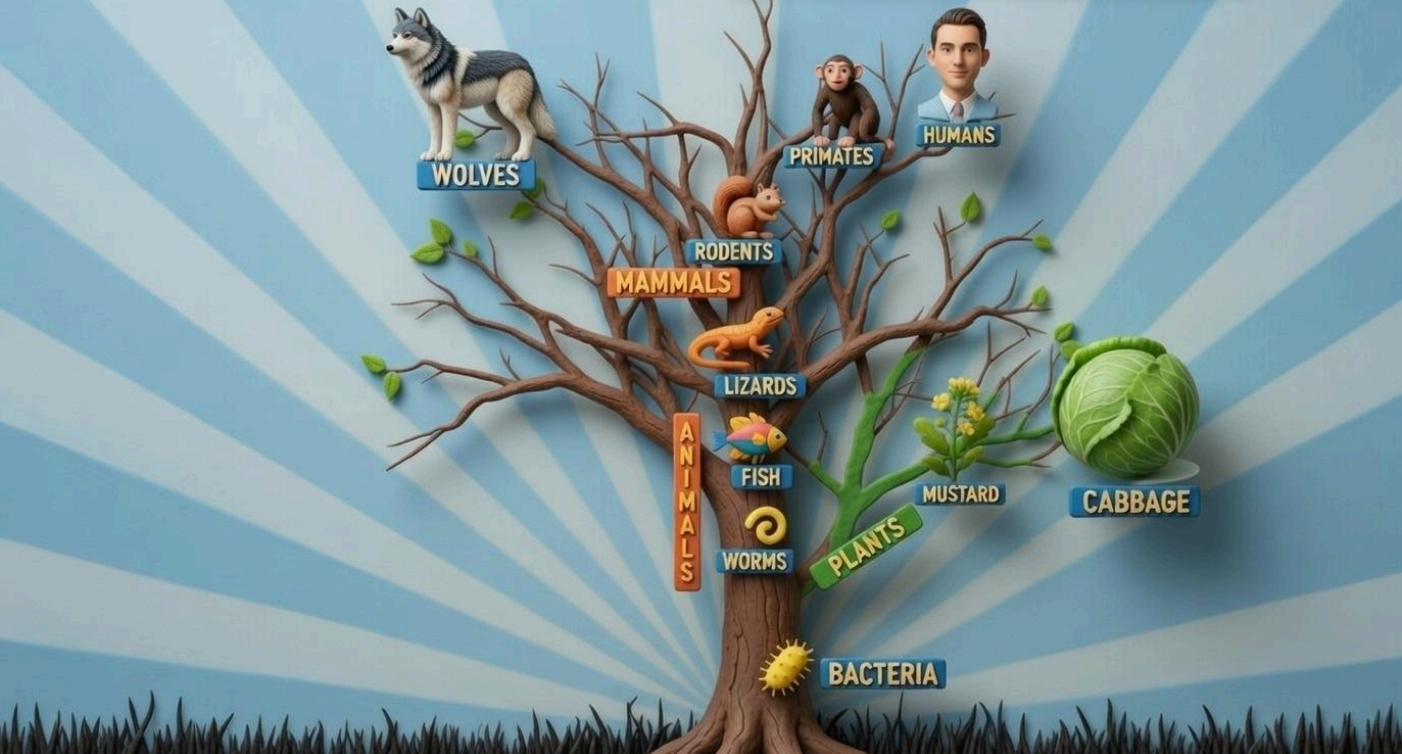 “We’re talking about the steps which take one kind to another. We’re not talking about a variety of dog giving rise to another variety of dog.”
“Why not? When wolves disseminated into four hundred kinds of pet shop dogs, that was evolution happening,” Carl insisted.
“We discussed this a few weeks ago,” Bill reminded Carl. “We agreed that since the evolutionary story is told in the Tree of Life, that we would base the definition on that tree. Also, Rent-A-Friend explained how the dissemination of wolves into dogs is basically dogs into other dogs, which is part of the creation model.”
“So, Rent-a-Friend, you’re focusing on the transitions between kinds up the tree,” asked Tom, “because it’s a primary difference between the evolution model and the creation model?”
“Yes, and not only that,” I replied, “but because it is a necessary part of the evolution story. If Darwinian evolution only allows dogs to make more dogs and doesn’t allow fish to make lizards which make rodents which make dogs, then it’s not going to make the tree of life which supposes to be the history of life on earth.”
“That makes sense to me,” said Tom.
Since Carl offered no further argument, I went on. “A bacteria does not have the genes it takes to make a worm,” I replied. “A worm does not have the genes it takes to make a fish. A fish does not have the genes it takes to make a lizard, and so on. Each new kind takes new genes that did not exist in the previous kind.”
“I think the point Rent-A-Friend is making,” said Bill, “is that there are only so many options. Either we have to assume that the genes to make a fish already existed in the earlier bacteria and worms, so the arisal of fish doesn’t demand new genes to come into existence. Everyone knows this is nonsense. But if the genes to make a fish did not exist in bacteria, somewhere along the line those genes needed to come into being.”
“Now, to clarify,” I continued, “there may be genes lost. Fish have gills, and thus the genes to make them. Lizards do not. So, the story must assume that the genes for gills can get lost along the way. This definition is not arguing that the total amount of DNA must increase at every step up the tree, nor the total number of chromosomes.”

“I think that sounds fair,” added Bill. “We do not have to believe that fish must have more DNA nucleotide base pairs than worms. We must only believe that, in order for worms to evolve into fish, they have to have the genes for fish parts added to their total collection of DNA.”
“Exactly,” I said. “This is what is meant by increases the genetic information in an organism. Not that they have more numerically, but that they have gained genes which their ancestors did not have, or as my definition puts it, ‘New genes which did not previously exist.’ To clarify further, if the genes for fins get changed into the genes for legs, such that the gaining of a new gene and the losing of an old gene is the exact same process, the fish and lizard will have the same number of genes, but the lizard will have a gene the fish did not have, and will not have a gene that the fish did have.”
“If I can make an analogy,” offered Tom, “we can think of a living thing like a factory. Say, worms are a factory that makes cars. For a car factory to make cars, they have to have the blueprints which tell them how to build it. So, if we think of worms as cars with no radio, and we think of fish as cars with a radio, then we can think there has to be an addition to the blueprint in order for the new kind of cars to begin rolling off the assembly line. Right?”
“Well spoken, Tom!” I replied. “And that brings us to the next part of my definition. It says
These new genes then cause an increase in physical complexity and associated behavior.
“If I continue Tom’s metaphor, let’s say that sales is the metaphor equivalent of survival.”
“So, the car sales of the fittest?” suggested Blue Beard.
“Something like that,” I replied. “Multiple versions of the automobile are out there. If no one buys a variety, it stops getting made. It goes extinct. If lots of people buy it, more will be made. So to follow the metaphor, it does no good to have the plans for a radio if the factory doesn’t actually make any cars with radios in it. The factory can have all the exciting new blueprints it can hold, but until those prints result in actual cars, it won’t affect sales at all.”
“I get it,” said Bill. “The new genes need to cause an increase in physical complexity and associated behavior, because if they do not result in any new physical trait then Natural Selection has no way of acting on those individuals. That’s what Darwin meant by ‘Variations neither useful nor injurious would not be affected by natural selection.'”
“Hold on,” said Carl. “Darwin said what?”
“Sorry,” said Bill. “Let me pull it up.” He tapped on his personal electronic device and read for us,
“..individuals having any advantage, however slight, over others, would have the best chance of surviving and procreating their kind[.] On the other hand, we may feel sure that any variation in the least degree injurious would be rigidly destroyed. This preservation of favourable individual differences and variations, and the destruction of those which are injurious, I have called Natural Selection, or the Survival of the Fittest. Variations neither useful nor injurious would not be affected by natural selection.” -Charles Darwin, On Origin of Species, 4th chapter, sixth edition.”
“Well, well,” said Carl. “I didn’t think any of you guys had ever cracked the cover of Darwin’s book. I figured you were just rejecting a book whose pages you’ve never seen.”
“Like you do with the Bible?” said Blue Beard behind a smirk.
Before Carl could retort, Bill continued making his point. “If a worm somehow gained the genes to make eyes, but didn’t actually have eyes, then he has no advantage over other worms. It is possible for genes to be inactive, you see. There are fish in caves who are blind; they do not have eyes at all, whereas their ancestors did have eyes. Those fish do carry the genes for eyes, but the genes are switched off.”
“If the cave contains eyeless fish, some of which have the genes to make eyes and others do not have the genes to make eyes, then the having or not having will make no difference to their ability to survive. Merely having the genes gives no advantage.”
“What maybe you guys don’t realize,” said Carl smugly, “is that this line of arguing assumes Natural Selection to be a fact of Nature. Which, means you are accepting evolution as true.”
“Oh for heaven’s sake, Carl,” grumbled Blue Beard. “You don’t listen at all, do you?”
“They are assuming Natural Selection to be true!” Carl retorted. “Nature acting on varieties to preserve some and destroy others is right out of Darwin’s book! Bill just read it to us!”
“It is from Darwin’s book,” admitted Bill, “but it wasn’t invented or discovered by Darwin. Darwin probably learned about it by reading the work of creationist Edward Blyth, who wrote on Natural Selection years before Darwin published.”
“And if you check your handy 3×5 note card,” I said, “you’ll see that evolution requires an addition of genes to a population, whereas Natural Selection merely removes genes. Thus, it is not evolution.”
“Of course it’s evolution!” barked Carl. “It’s in the title of Darwin’s book! Origin of Species by Means of Natural Selection!”
“Carl,” said Bill in his hypnotically calming voice, “do you not agree that turning a worm into a fish must require the addition of new genes — genes which the worms did not previously have?”
“Well, sure. I suppose.”
“And when Natural Selection causes a variety with what Darwin called injurious traits to die out, does that add or remove genes from the population?”
“It removes genes, obviously. But that allows the fit to survive. As Darwin said, it preserves the superior, beneficial genes.”
“And when Natural Selection preserves beneficial genes, is it making new genes which previously did not exist, or is it keeping existing genes in the gene pool?”
“It’s keeping existing genes. You can’t preserve something which doesn’t exist. I know that.”
“Then Natural Selection doesn’t make any new genes, does it?”
“No.”
“And by definition, Darwinian evolution needs to make new genes which did not previously exist.”
“By his definition,” Carl said, pointing at me.
“Carl,” I said. “If you don’t like my definition, then just explain to us how you get a worm to evolve into a fish without making any new genes, like the genes for fins, eyes, and gills.”
Carl crossed his arms and looked offended, so it seemed the matter was dropped for the time being. I strongly suspect Blue Beard would have taken the opportunity to get a rise out of Carl due to his having to concede a point were he not distracted by the arrival of our mountain of Nachos. Whatever differences we may have are set aside when we must join forces in order to take on the Nachos.