 Doug Velting
God has programmed the tiny ant to do huge things.
The Sahara Desert Ant
This ant lives in northern Africa and has impressive navigational skills. These desert ants are only a quarter of an inch long, and yet they search for insects that have died in the desert heat, at times more than 300 feet away from their nest, well beyond their line of sight.
Research has shown that they do not use odor trails like many ant species because the desert heat evaporates the chemical trail too quickly, and they are not dependent on visual landmarks. However, these ants can accurately find their way home, even if they make a circuitous outbound route.

The Sahara Desert ant uses different means of navigation, visual landmarks (close to home), and memories of the route taken; sort of a roadmap of the surrounding area. They also use path integration, allowing the ant to maintain a global compass that points back to either its starting point or to a feed site it visited earlier. This desert ant knows and remembers how far it has traveled and uses that knowledge to determine the best route back to its home nest.
The Leafcutter Ant
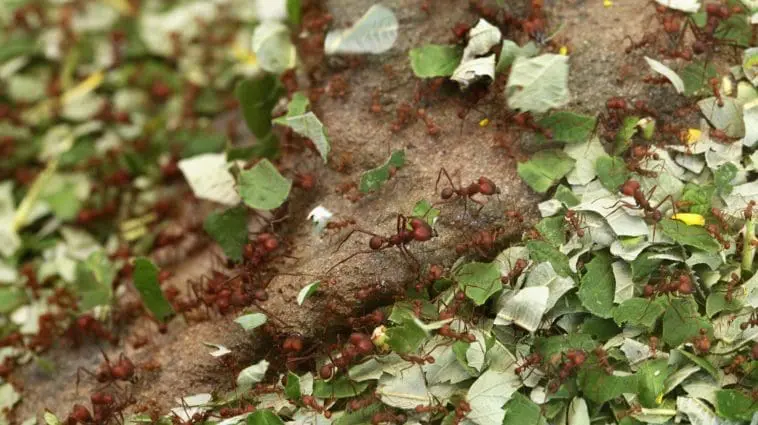
This type of ant lives in the rainforest of Central and South America in colonies numbering in the thousands. With their tiny brains, God has given them the knowledge to farm a fungus crop that they feed on.
These ants climb trees in the rainforest and using their sharp mandibles cut leaves to provide the fungus a type of mulch. They are very skilled at their work, positioning themselves to cut the leaves efficiently and in the right size pieces to be carried back to the nest. The larger worker ants are equipped with specialized mandibles and are up in the trees cutting, while smaller worker ants wait for the fallen pieces to carry back to the nest.
It is an amazing sight to see a trail of hundreds of ants each carrying a piece of a leaf in single file back to the nest. When the leaves are delivered, other ants prepare the pieces for the fungi to use. First, the outer waxy layer needs to be stripped away, and then the pieces need to be shredded. The type of fungi that this species of ant farms will break down the organic material in the leaf, including cellulose, thus turning an inedible leaf into ant food. The fungi get what they need by breaking down the leaf and the ant gets what they need in food.
The leafcutter ant is a meticulous farmer, maintaining the best condition for the fungus. They carefully select only the leaves that the fungus needs to grow well, disregarding trees with leaves that have harmful chemicals. The ants are careful to cultivate only their desired variety of fungus, preventing different strains from “infecting” their farm crop. They even produce growth hormones and antibiotics to discourage competing fungi and microorganisms.
Arboreal Ants
Most species of ants live underground or in ant mounds, but there are a few that live in trees. One of those ants is the weaver ant. These ants build nests the size of soccer balls by weaving leaves together. Weaver ant colonies consist of perhaps a hundred nests spread over several trees and numbering a half million ants.
These ants, which live in the rainforests of Africa, Asia, and Australia, weave leaves without detaching them from the tree. The leaves are alive and still performing their function for the tree. What is amazing about the construction of the nest is the teamwork of the ant colony. One, two, or even three ants can’t maneuver the leaves in the right position to form the nest, but the entire colony works together without a “boss,” or a leader.

It is interesting that when a small group is doing well at maneuvering leaves on a certain section of the nest, another small group will come and assist them.
They join the leaves by aligning the two edges and then drawing them together. The leaf edges are glued together using the silk of the ant larvae. This is the silk that the larvae normally use for their cocoon, but it is essential for the building of the nest. The ants, in essence, use the larvae as a tool, forcing the silk out precisely along the leaf edges in the same way as a child using Elmer’s glue in a school art project.
It would be foolish to consider that all of this ability that the ant has and all of the information in its tiny brain came about by chance. We don’t see this amazing creature by way of evolution. Only the Genesis account of creation could explain this.
Go to the ant, O sluggard; consider her ways, and be wise. Without having any chief, officer, or ruler, she prepares her food in summer and gathers her sustenance in harvest. (Proverbs 6:6–8)