 Jack Hollander
By marine biologist Jack Hollander
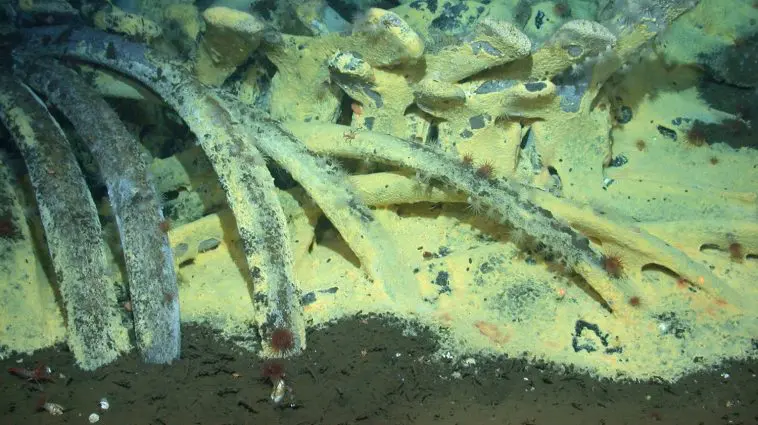
When a whale dies, it doesn’t just vanish. After enough of the soft tissue has decayed, the skeleton and remaining material sink to the bottom of the ocean, often far from the coast. This is known as a whale fall.
These whale falls soon form micro-ecosystems embedded within the broader, well-established deep ocean ecosystem. They provide structure for creatures that live fixed in place, such as worms and corals and also provide shelter for prey animals and a feeding zone for predators. Eventually, the tiniest remnants sift into the sediments, helping even the micro-organisms thrive.
Whale falls are a rare find for scientists since they are usually located in deep waters and are made from only the fragmentary remains of one individual or even an incomplete specimen. The more common types we have found in recent years are from species such as humpback, sperm, and gray whales.

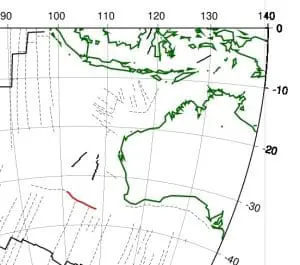
Unlike today’s individual falls, new evidence has unearthed a whole zone of fossilized whale falls consisting of not just one, but 476 individual specimens representing several species. The massive graveyard winds through the trenches and mounds of the “Diamantina Zone.” This is a fault line area that stretches for 1200 kilometers, or about 750 miles, across the deep ocean floor off the coast of Western Australia.
The fall zone lies nearly 20,000 feet below the surface of the ocean and supports unique micro-ecosystems. Species such as snailfish, eelpouts, and cusk eels are trademark organisms for deep sea whale falls found in the Indian Ocean. These organisms are found in cold water, which is somewhat rare for the Indian Ocean.
Most of the Indian Ocean’s surface fauna is warm-water centric. However, the Diamantina Zone is so deep that it transitions into a cold-water ecosystem in contrast with the shallower surrounding waters. While these creatures scavenge remaining tissue and use the bones as shelter, corals, sea squirts and salps cling to the skeleton for structure.
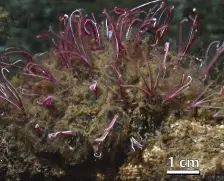
Osedax worms are also well-known creatures that use whale falls to their advantage. They are so effective at eating whale bones that their presence is a key factor in the rarity of whale falls. How do such soft creatures consume such mighty bones?
These worms have a mutualistic relationship with bacteria living on whale skeletons. As the bacteria dissolve the osseous tissue, the worm will absorb the liquified bone and burrow deeper into the skeleton. This system works so well that the presence of Osedax has been shown to exponentially decrease the percentage of skeletal completion of a whale fall specimen.
Today, these worms have only been found on unfossilized specimens in the Diamantina whale fall. This is because the fossilized specimens no longer have any food for them since the bone has been replaced by rock and mineral deposits. However, the fossilized remains contain Osedax borings, showing they were eating away at the bones before the fossilization took effect.
The fact that the whale bones of many of the Diamantina specimens fossilized before the Osedax worms degraded them is truly impressive.

Dating the fossil whale falls of the Diamantina zone has proven to be problematic for the secular community. Geologically, the zone has been dated to 50 to 60 million years old. However, the whale fossils themselves are thought to be only around 5 million years old. They chose this much younger date to coincide with the dating paleontologists have used for two of the extinct whale species, namely Pterocetus and Izikoziphius.
Pterocetus and Izikoziphius could have been dated to 50 million years old, to match the canyon. However, there are evolutionary story issues that make such a pushback uncomfortable. Pakicetus and Ambulocetus are commonly assumed to have been part of the whale evolutionary line, and they already claimed the date of 50 million years old. Thus, the whale fall can’t have happened while their evolutionary ancesters were still roaming the dry land!
While the geologists would be comfortable with the older date, their evolutionary compatriots couldn’t allow it. So, they label the fossilized bones at a much more comfortable date of just 5 million years ago, creating a conveniently perfect time-slot for the two modern species also found fossilized in the zone. The geologists can just put up with this date shifting.
The whale fall of the Diamantina Fracture zone is a truly remarkable discovery. A colossal graveyard of whale skeletons, both modern and fossilized, managed to evade total decomposition and scattering. We still have questions about how they could have fossilized too quickly for the Osedax worms to finish their decay process and what the secular community will do with the timeline contradictions.
Thanks to the discovery of this zone, scientists can unearth realms of new research topics.