 Bryan Melugin
[Originally published as part of Thursday Night Nachos: Defining Evolution to Debunk Darwin]
Defining Evolution 4: More Failures to Define
“Last time we was here, our friend here,” Blue Beard said, gesturing to me with his root beer, “had given us a few points which I think we all agreed was acceptable for a definition of Darwinian Evolution. Can you recap those for me, lad?”
“Sure thing,” I said:
- Evolution has to do with living things.
- Evolution has to do with life changing over time.
- The idea of evolution is is intended to explain the origin of different kinds of plants and animals.
- Evolution tells a story where in all living things arose through past common ancestors until, far enough back in time, we reach a universal common ancestor, making the history of life on earth a big tree of life. Or going forward in time, it explains how simple things like bacteria became worms which became fish which became lizards which became rodents which became primates which became humans.
“But I think we agreed,” said Tom, “that evolution doesn’t exclude other things — like extinction events, or stasis.”
“That’s right, Tom,” I said. “This list is merely meant to whittle down the events to the ones which are in fact evolution happening.”
“And Carl,” said Bill, “you’re still okay with everything in those four points? Nothing strike you as stacking the deck against evolution being true?”
“It’s fine,” said Carl. “But like I said last week, I think we can leave the definitions to the professionals. I’ve got a list of definitions that I got from some biology textbooks which, while each a little different, still work according to this list and which I think are good enough for us.”
“Break it out then, Carl,” I said, saluting him with my root beer.
Carl took a sip of his own frosty beverage and then pulled out a pad of paper. “Here’s something so basic they put it in the title of the textbook. Evolution is, simply, ‘Change over time.’” He tossed it on the table and looked at us. “Even you can’t disagree with that.”
“I’ll agree that evolution is about change over time,” I said, “but that is nowhere near a clear definition. Everything changes over time. By this definition, everything in the universe is evolving, which means the word just means, “Things happen.” Which is true, but hardly worth saying.”
“Remember those four points from last week,” said Bill. “Evolution has to do with living things. And even if we saying ‘Living things changing over time,’ we’ve still not said anything with clarity.”
“Living things get hit by trucks and die,” said Blue Beard, “which is a change, but not evolution.”
Carl begrudgingly picked up his little notebook and looked at it once more. “OK, here’s a definition which is specific to living things. ‘Evolution is Descent with Modification.'” He tossed down his notebook in victory.
“No, no,” I said. “Modification is too vague a term to be useful here.”
“It means change,” said Carl, somewhat condescendingly.
“I know it means change,” I said, “but it doesn’t specify what kind of change. Genetic decay that causes the eventual extinction of the species is modification. That is hardly evolution since, as we discussed previously, dead things don’t reproduce.”
“Also,” said Bill, “with the exception of a few wee terrible beasties, all living things are different than their parents. But this would imply that every living thing which is not an exact clone of its parent is an example of evolution.”
After some spluttering, Carl picked up his notebook and continued with the next definition. “This is quoted on Talk Origins,” he said, “’from the 1989 textbook titled ‘Biology’: ‘Evolution can be precisely defined as any change in the frequency of alleles within a gene pool from one generation to the next.’”

“Hold on, remind me what an allele is,” asked Tom.
“An allele is a variation on a gene,” said Bill. “You know how DNA is the code for life — the written instructions on how to build living things? And sections of DNA which code for a particular feature, say, the color of your eyes, are called genes? Well, a gene can have variations for the same feature.
“For example, in any person there are two genes for eye color. Those genes might be the same, such as if you only have the gene for brown eyes. However, there exist a variety of possible genes for eye color which can make blue eyes, or green, or hazel eyes. All of those genes for the same trait, in this case eye color, are alleles, or variations for the same trait.”
“So evolution, says they, is a change in the frequency of gene variations.” Blue Beard thoughtfully slurped some root beer. “And by frequency they just mean… frequency? Like, how many are there from one headcount to the next? So this whole blessed definition is just about math? Counting genes?”
“No,” said Carl. “It’s about how the part of a population carrying one allele versus another will change over time. It’s how populations evolve.”
“Which is just math,” said Blue Beard. “When you say a population has evolved, you’re saying there has been a change in allele frequency. And when you say there’s been a change in allele frequency, you mean there has been a change of how many members of that population have one gene compared to another.”
“Well… yes,” said Carl. The look on his face seemed to indicate that he had not thought about it in those terms before.
“Maybe we need an example,” suggested Tom. “To illustrate what all of this means.”
“I’ve got one,” said Bill, “which will no doubt be in all of your biology textbooks. They’re called peppered moths.”
Carl pulled out a middle school text book and flipped for a moment until he found the page he was looking for. “Here they are,” he said, showing us the illustration. “Peppered moths come in two varieties. One is primarily charcoal in color, the other a primarily white color.”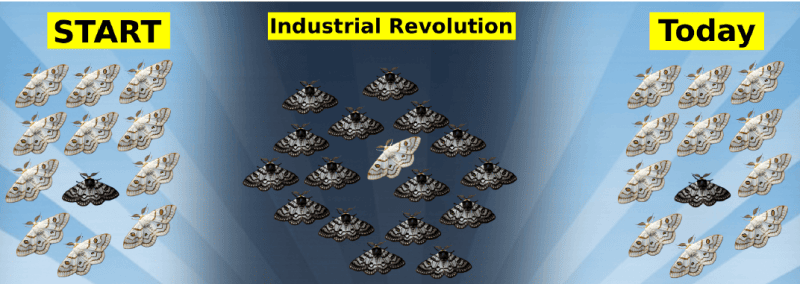
“So these moths,” explained Bill, “live among trees which are fairly light in color. In any average population, the light moths make up 95% of the population, because they can hide real easy on those trees, you see, and the dark moths make up only 5% of the population on account of not being able to hide on the trees and the birds eat them and they die.”
“I think I get it,” said Tom. “95% light moths and 5% dark moths, mainly because of camouflage options.”
“That’s right!” sad Bill. “Until the Industrial Revolution. The factories started belching out smoke. And the trees got all covered with soot and dirty and so were much darker. This was wonderful for the dark moths. And the birds ate the light colored moths until 95% of the population was now dark moths, and only 5% of the population is light moths. And that, jack, is a change in allele frequency. Deal with it.”
“So the population changed in terms of which version of moth was the most common?”
“That’s the whole truth,” said Bill.
“And this is a change in allele frequency in a nutshell,” said Carl, “that’s literally a textbook example.”
“So, when the story began,” said Blue Beard, “there was light and dark moths. When the story ended, there was light and dark moths.”
“Well, yes,” said Carl, “but in different percentages of the total population.”
“Am I amiss, or is this merely a change in numbers?” said Blue Beard inquisitively.
“Blue Beard is right,” I said. “This is another popular failure. A change in allele frequency is not an evolutionary change because it is not a genetic change. It’s a statistical change.”
“It’s a change in the genes!” said Carl. “It’s a change in the gene frequency.”
“No,” I replied. “It’s not a change in the genes, it’s a change in the statistics. That’s why it’s called a change in allele frequency and not a change in alleles. The population didn’t gain any new genetic information. Just like Blue Beard pointed out — there’s no new variety of moth.”
“Yeah, Carl,” said Blue Beard somewhat agitated. “I thought we was supposed to be explaining where new kinds of things come from in the first place. You want to tell us how changing how many peppered moths you got explains where peppered moths come from in the first place?”
“Well, it’s not entirely meant to…” began Carl, looking a little sheepish.
“Then why did you bring it up!” shouted Blue Beard. “Didn’t we say just a few minutes ago that this evolution business is supposed to explain the origin of plant and animal kinds? And you go bringing up census information?”
“It’s a very popular definition!” answered Carl. “It’s in biology textbooks! Perhaps you guys simply don’t understand.”
“Carl,” said Bill calmly. “Does or does not your textbook use the peppered moths as an example of a change in allele frequency?”
“It does.”
“And did or did not I explain accurately what the book says about the peppered moths?”
“For the most part. I mean, the story doesn’t really end there. The clean air act of the 1960s reduced the soot output of those factories until the trees returned to their original color, and then the population of the peppered moths returned to their original percentages.”
Carl flipped through the pages in his textbook as if he was looking for his next thought, but it seemed as if he never found it. “So, there was an additional change in allele frequency,” he added with a shrug.
“So is or is not Blue Beard correct,” continued Bill, “when he says there was no new varieties of moth created in these events?”
“Well, yes. He is correct.”
“And is he not also correct that this is in fact, census information.”
“Well it’s not.. I mean.. I wouldn’t call it that. But, yes.”
“So, Carl,” said Bill smoothly, “will a change in allele frequency ever create new genes that did not previously exist?”
“Not by itself, no.” Carl admitted.
“Then I think we can agree that this definition is insufficient,” said Bill.
“I’d agree,” said Tom. “You can’t make anything new merely by comparing numbers. That would be like trying to make money by balancing your checkbook.”
“Good analogy, Tom,” I said.