
 Jay Wile
[Originally published as Bugs and Bacteria Working Together]
Mutualistic symbiosis, the process by which organisms of different species interact so that all of them benefit, is a very common phenomenon in creation. A study in the Proceedings of the National Academy of Sciences, USA highlights an interesting case of mutualistic symbiosis that not only has important implications for farmers, but also relates to the creation/evolution controversy.
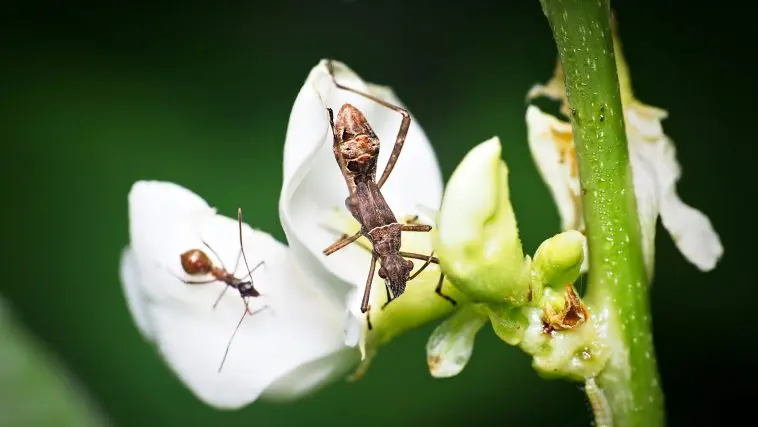
The study examined insecticide resistance in bean bugs (Riptortus pedestris) and similar insects. The authors considered one of the most popular insecticides used by farmers across the world, fenitrothion. It has been known for some time that certain insects, such as the bean bugs in the study, can develop resistance to that insecticide. This is a problem, since bean bugs not only damage bean crops, but also some fruit crops.

The authors were interested in what causes this insecticide resistance. As they state in the introduction to their paper:
Mechanisms underlying the insecticide resistance may involve alteration of drug target sites, up-regulation of degrading enzymes, and enhancement of drug excretion, which are generally attributable to mutational changes in the pest insect genomes.
In other words, when an insect develops resistance to an insecticide, it is generally assumed that there was a change in the DNA of the insect. A mutation might have damaged the site where the insecticide is supposed to bind; the activity of a gene involved in the destruction of unwanted chemicals might have been enhanced so that the insect destroys the insecticide; or perhaps the activity of a gene involved in getting rid of waste is enhanced so that the insect just excretes the insecticide.
The authors show that for the specific case of fenitrothion resistance in bean bugs and similar insects, none of these mechanisms play a role. Instead, bean bugs develop their resistance to fenitrothion thanks to a bacterium from the genus Burkholderia that lives in their gut.
The symbiotic relationship between this bacterium and bean bugs has been known for quite some time. According to the authors of the study, the larvae of the bean bugs (which live in the soil) acquire the bacteria (which also live in the soil). By the time the larvae have matured into adults, they generally have about a hundred million of the bacteria living inside them. Adults that have the bacteria grow larger than those that don’t have the bacteria, which demonstrates that even without insecticide, the bacteria are beneficial to the insects.
In places where fenitrothion is used, however, the insects benefit from the bacteria even more.
It turns out that some strains of these bacteria are able to digest and use fenitrothion, but others are not. As a result, when the insecticide is sprayed on crops, strains that can digest it have a big advantage compared to those that can’t, and they quickly become the dominant strain of the bacterium. Bean bug larvae that live in the soil then pick up these fenitrothion-digesting bacteria, and as a result, they become resistant to the insecticide.

Obviously, then, bean bugs do not become resistant to the insecticide because of changes to their DNA. Instead, they become resistant to the insecticide because they pick up bacteria that make them resistant to the insecticide.
But what about those bacteria? How did they become able to digest and use the insecticide? While it is tempting to think that they developed this ability because of a change to their DNA, that probably isn’t correct. As I have already pointed out, we now know that bacterial genes for antibiotic resistance existed back when mammoths were alive, so they were not formed in response to modern antibiotics. The most likely explanation for fenitrothion digestion in bacteria, then, is that some strains of the bacteria have always had the genes necessary to digest the insecticide, and the use of the insecticide just makes those strains more likely to survive.
So how does this relate to the creation/evolution controversy?
I see two implications. First, as the authors themselves say, it is tempting to explain insecticide resistance as an evolutionary change to an insect’s genome. However, that clearly isn’t always the case. Just because an insect suddenly develops resistance to an insecticide, we can’t immediately assume that it is the result of a genetic change that has been acted on by natural selection. It could be the result of a symbiotic relationship, as has been shown to be the case here.
Second, some creationists maintain that the initial design for bacteria, viruses, and many fungi was purely beneficial to plants, animals, and people. In their view, these microscopic entities acted as a “bridge” that linked plants, animals, and people to their chemical-rich environment. In other words, they acted like tiny chemical processing plants, converting the chemicals in the environment into chemicals that the larger organisms could use. This study seems to support that view.
In this case, a chemical that was introduced to the environment and could have harmed the insects was degraded by bacteria so that, at minimum, the insects were not harmed. While the study didn’t touch on this, since the bacteria benefit from the chemical, it is reasonable to assume that the insects benefit as well, at least indirectly. If that’s the case, the bacteria transformed a potentially deadly chemical into something beneficial to the insect.
If nothing else, the study shows that God designed different ways for the organisms in His creation to adapt to changes in their environment. Genetic change is one way, but there are clearly others, some of which have not been studied very closely.