
 CreationStudies Institute
[Originally published as Carved In Stone: Where Two Worldviews Collide]
Is the biblical account of a worldwide flood, as mentioned in Genesis, a reality? Did the forces that caused this powerful, tragic global catastrophe come from beneath the Earth’s crust? And did it happen, as Genesis states?
In the six hundredth year of Noah‘s life, in the second month, the seventeenth day of the month, on that day all the fountains of the great deep were broken up, and the windows of heaven were opened. (Genesis 7:11)
Advertisement Below:
If it is true, geological evidence of changes in Earth’s crustal structure causes by a catastrophic global event like the Genesis flood should be present. Before the late 1700s, there was a common belief that the Earth was young — only a few thousand years old — mainly based on a biblical timeline of around 6,000 years. Early geologists examining Earth’s rocks, fossils, surface formations, and processes looked for signs of the worldwide flood, which they believed would leave clear marks on the Earth’s surface.
One notable study was conducted by Bishop Nicolas Steno (Latinized), or Niels Steensen in Danish (1638- 1686), a renowned Danish scientist and theologian known for his significant contributions to geology. He is called the father of geology because he established fundamental principles in stratigraphy, explaining how rock layers form over time. With a keen interest in fossils, he emphasized their importance in understanding Earth’s history.
Steno was dedicated to the Word of God and used the biblical timeline to determine the order in which rocks formed. The first period was the Creation Week, during which the foundational rocks were deposited. The second was the Genesis Flood, during which waters reshaped the Earth’s surface as sedimentary rocks—composed of sediments—were laid down in layers worldwide, covering about 70 percent of the continents today. Steno believed that retreating waters would cause significant erosion on the continents. In his Dissertations Prodromus (1669), he laid the foundation for geological stratification, now known as Steno’s Law of Superposition.
Steno’s young-earth geological theory of a global Flood was challenged by other viewpoints, such as those of John Hutton (1726–1797), a Scottish natural philosopher and physician who rejected the biblical account of Genesis and relied on naturalism to explain Earth’s crustal changes. In his publication, Theory of the Earth, he proposed that the Earth was in a constant state of renewal through slow, deliberate geological processes over immensely long periods of time.
Hutton believed this was an everlasting cycle in which rocks erode and eventually become part of the earth, then form anew through underground magma and volcanic activity. His theory aimed to support the concept of deep time, in which change occurs over millions and billions of years through observable forces such as erosion, sedimentary rock formation, and mountain uplift, as seen today. He called this the Uniformitarian Principle, “The present is the key to the past.” With this principle, he suggested a natural system operating without any global catastrophic events, such as the Creation event or the Genesis Flood.
Hutton’s uniformitarianism was initially not well received. If it weren’t for Charles Lyell (1797–1875), a Scottish lawyer and recognized geologist, who revisited and clarified it with renewed vigor, uniformitarianism as a principle or law of nature might not have gained traction.
Lyell emphasized that the geological processes we observe today operate at their current rates, causing gradual change over deep time, and that these processes are constant. This theory rules out the Genesis Flood, the biblical Creation Week, and anything supernatural affirmed in the Word of God. Lyell’s theory is now considered a foundational concept for all geology, emphasizing that nature is self-sufficient.

Lyell published his theory of uniformitarianism in a three-volume series titled Principles of Geology from 1830 to 1833, which became a great success. Lyell’s principles are still used today with some adjustments. While Lyell’s work was focused on geology, it is considered one of the most important contributions to evolutionary theory. It provided essential support because, without the concept of deep time based on uniformitarianism, the small, gradual biological changes necessary for the evolution of new species would not be possible.
Darwin emphasizes this point in Chapter 4 of his Origin of Species (1859), stating,
“Natural selection can act only by the preservation and accumulation of infinitesimally small inherited modifications, each profitable to the preserved being.
He highlights the concept of gradual change over deep time in Chapter 9, writing,
“He who believes that geological strata have been slowly deposited … will not hesitate to believe that species may have been as slowly modified.”
Darwin’s theory of evolution and Lyell’s principle of uniformitarianism mutually depended on each other for their survival. They have formed an inseparable bond since Darwinian evolution emerged nearly two centuries ago, feeding off one another and defying God’s Word. The concept of deep time exists because it serves as the evolutionist’s magic wand, enabling amoebas to turn into humans. It is taught dogmatically in our schools, often ignoring clear geological evidence in fossils and rocks that shows the Earth experienced worldwide catastrophic events throughout its history.
Instead of turning to God, who made everything—the universe, the Earth, and all living things—the One who is the ultimate source and Creator, they rely on nature’s time and attribute to it unlimited power to create evolutionary change.
The uniformitarian deep time concept was formally challenged in 1961 by a creationist worldview, supported by both theological and scientific arguments, through the publication of The Genesis Flood by John Whitcomb (1925–2020) and Henry Morris (1918–2006). The authors aimed to present an apologetic case supporting the biblical account of Genesis, including a young-earth perspective and a global flood. This followed the traditional model, where Bishop Steno and other early geologists adhered to the biblical timeline. Morris’s strong scientific arguments were a significant part of the book, as he conducted research using a wide range of sources.

Through the efforts of Whitcomb and Morris, the modern creation movement gained significant momentum, which extends worldwide, along with various creation organizations that have emerged, including the ministry I have been part of and blessed by since 1988—the Creation Studies Institute (CSI), now part of Coral Ridge Ministries (CRM). The movement influenced pastors, evangelists, and theologians, exemplified by my pastor and mentor at that time, Dr. D. James Kennedy (1930–2007), the founder of CRM. He stated that the teaching of evolution was the root of many of society’s great ills.
Whitcomb and Morris awakened the Christian world to the idea that there was an alternative perspective on earth science that affirms God’s Word. And this scientific confidence has impacted millions by affirming their faith and leading others to Christ.
There are two main worldviews:
secular evolutionists who rely on nature rather than God, and creationists who follow the biblical account of origins. Both examine the same evidence — rocks, fossils, canyons, rivers, and mountains — but interpret it differently based on their worldview. When the assumptions of old-earth uniformitarianism are set aside, the evidence reveals widespread crustal change best explained by the Genesis Flood.
In summary, the geological evidence strongly supports a worldwide flood as described in the book of Genesis.
The Earth’s rock layers are laid down sequentially, like a layer cake, one layer at a time. This process happened quickly, rather than over millions of years, because the layers did not change. If they were exposed for a million years, they would have changed due to geological forces such as erosion, plate tectonics, volcanism, and biological activity.
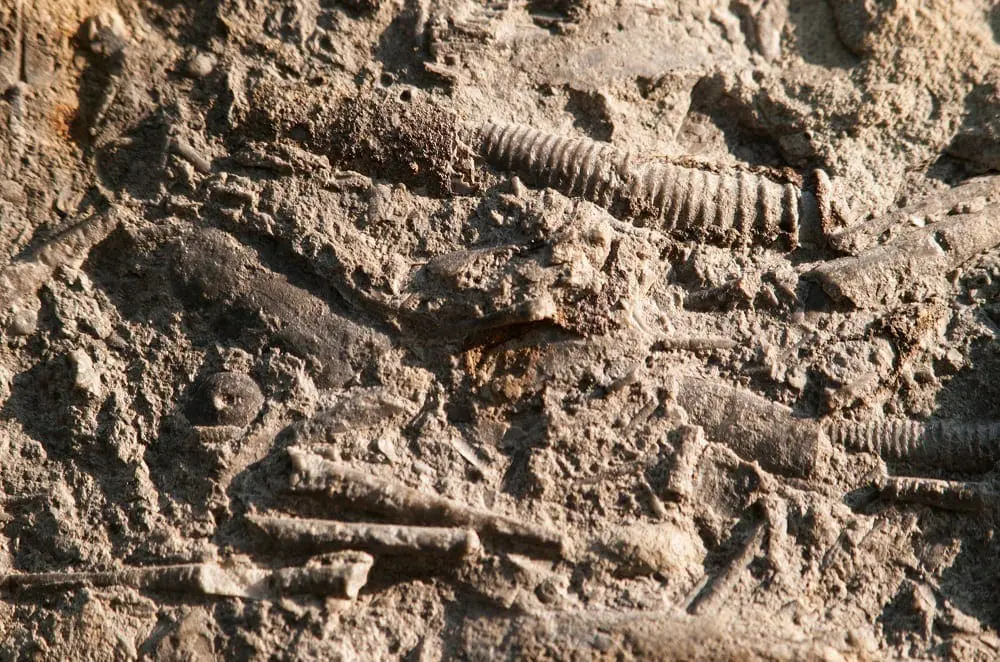
Sedimentary rock layers cover 70% of the continents, and 95% of the fossils they contain are made from marine creatures, suggesting that oceans once covered the entire Earth. The billions of fossils found in graveyards worldwide indicate rapid burial by water or volcanic activity, pointing to a Genesis-level catastrophe.
God’s Word is truth and gives light to our understanding. When it comes to our history and where we come from, let the One, Jesus Christ, who was there, speak, and we will listen.
In the six hundredth year of Noah’s life, in the second month, the seventeenth day of the month, on that day, all the fountains of the great deep were broken up, and the windows of heaven were opened. (Genesis 7:11)
By Tom DeRosa