 CreationStudies Institute
[Originally published as Threads of Wonder: Discovering God’s Handiwork in the Spider]
Why do spiders exist?
The insect world features all kinds of small creatures with mind boggling features. These include their ability to defy gravity with their wings, their rapid population growth, and their complete body transformations from larva to pupa and then to adult. Insects make up between 75 to 80% of all the named species on Earth.
It’s estimated that right now, 10 quintillion insects — that’s a 1 followed by 18 zeros — are alive and occupying every land niche where life exists on Earth. They reproduce at such levels that they interfere with our lives and can overwhelm other biological communities. So, why hasn’t the world been completely overrun by them? Because God has implemented various population growth control plans, including natural food chains where insects feed other insects, reptiles, and arachnids, including spiders.

The Creator has a good sense of humor. Spiders have remarkable features that make them excellent predators of insects, yet many humans are afraid of them. In fact, there is a disorder called Arachnophobia, defined as having such an intense and irrational fear of spiders it can lead to symptoms like anxiety and panic attacks. Humans have little need to fear spiders, as our Creator designed them to control insects that can be a nuisance and spread diseases.
Spiders are exceptionally well-equipped to eradicate as many insects as possible. All of the 46,000 known species of spiders are characterized by their eight legs and capacity to build sticky webs that allow them to trap prey — often, even in flight — and then immobilize. kill, and digest them with venom from their distinctive fangs.
Facts on Spiders
Most insects possess two compound eyes, composed of many lenses arranged in a mosaic spherical pattern. It is no wonder it’s hard to capture a fly because it can see in every direction. In comparison, spiders have simple eyes, with many having four pairs, while others have three, two, or even none.
Their eyes are classified as simple, like humans, with one lens focused on the retina, which receives signals sent to the brain. A human retina has many more photoreceptors, which gives a much sharper image, but a spider, with its numerous eyes neatly arranged on its head, can pick up motion and recognize images all around it. Spider eyes work best in low light to identify motion.
Why does a spider have so many legs? While insects manage their lives with three pairs of legs, a spider needs an extra pair for balance and control when walking on their web, moving vertically along the wall, and walking upside down on the ceiling. Their legs are long and slender, with six joints each, this means that spiders have 48 bendable knees, providing a broad base and extra stability, which makes them appear much larger than their actual body size.
Their legs are flexible and strong, allowing the front legs to hold onto the web while the rear legs assist in weaving and assembling it simultaneously, which is completed quickly. Spider’s legs are moved hydraulically by blood pressure rather than by muscles only. Their long, thin legs are covered with tiny hairs sensitive to vibrations and smells, similar to an insect’s two antennae, and are prominent on their heads. A spider has three additional pairs of legs, increasing its sensitivity threefold. This is why spiders are extremely quick to respond to motion in their webs.
Those legs also make spiders are also hard to catch because they are fast sprinters. Those who own tarantulas, a large version of hairy spiders, can tell you all kinds of stories of their ability to move quickly once they get loose.

A spider’s body is usually small compared to the space the legs occupy. Their body is easily distinguished from an insect in that it is composed of two parts: the cephalothorax, which is the head fused to the chest or thoracic cavity, and the abdomen. Their eight legs are evenly spaced around the cephalothorax, with the abdomen protruding out in an ideal position for producing and laying down silk in place during the construction of its web.
The Natural Wonder: Building a Silk Web
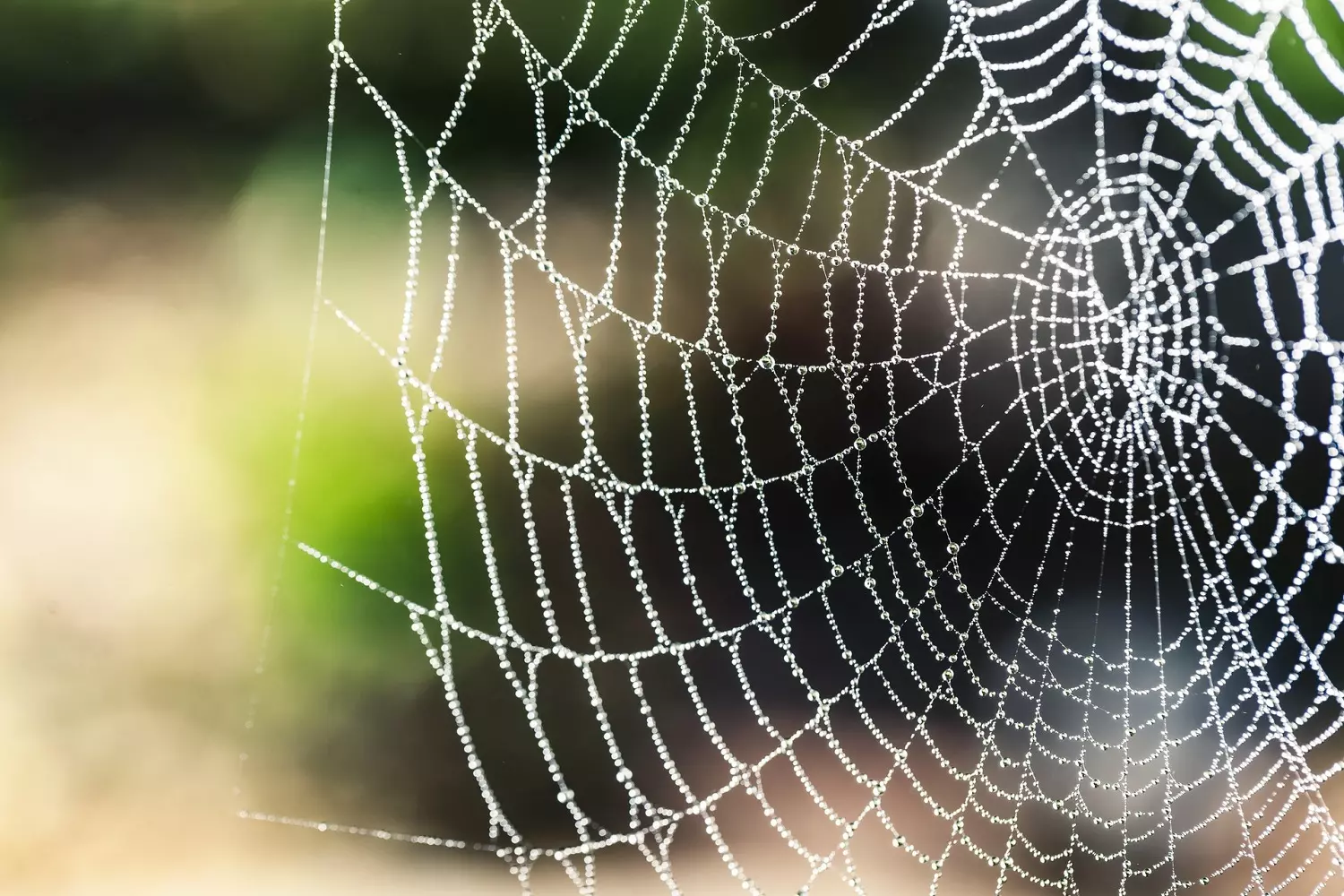
Most of us have accidentally brushed into a spider’s web and felt the web’s sticky silk. It is not a pleasant experience to try to remove the silk strands from your hair, skin, and clothes. This inconvenience can make you appreciate the biological marvel of a spider that possesses a silk factory capable of producing an abundant supply of several different types of silk.
For instance, are special types of non-sticky silk used to create the draglines that form the strong outer framework of the web along with thread for them to perch on without becoming entrapped themselves. Their best known silk is the sticky type, made with droplets of strong adhesive to trap prey. When their eggs need protection, spiders produce specifically designed silk for that purpose, as well as another type used to wrap their prey.
There is a finally kind of silk that allow some spiders to fly, or rather “balloon.” These threads catch the wind, allowing the spider to ride up to a thousand feet above the ground, travel for miles, and settle in a new location. Observers have seen Jaro spiders migrating from Georgia as far north as Maryland, and as far west as Oklahoma, using this ballooning method. These invasive species, native to East Asia, are larger than most spiders found in America, making them easily noticeable due to their distinctive dark blue and bright yellow markings.
The spider’s silk factory is a wonder in itself, located at the back of their abdomen. Each kind of silk is made from a complex liquid protein manufactured in one of 6 to 8 pairs of glands. The liquid protein flows into a spinning duct, which aligns the proteins and removes the water to form a solid. This solid then moves it into the spinnerets, which function as specialized nozzles that produce the exact amount and correct composition of silk required for web building or any other function.
Most spiders have three pairs of spinnerets. This amazing function is too complex for humans to reproduce with our best technology. This complex process allows the spider to produce a silk with a strength five times that of steel and the flexibility to stretch up to five times its original length.
The eloquence in its design doesn’t end with the spider’s production of silk. The orb web is a masterpiece in action, constructed with various types of silk in a remarkably short period. It takes an average of one hour to make several feet of web. The spider acrobatically move through space, letting the wind carry the silk and bind it to another object, creating a straight line for them to walk on, which becomes a tightrope. They proceed to throw down another silk line to the ground, making three spokes, which they reinforce to begin their construction of the orb web. It is a marvel to observe how tightly and efficiently the finished web captures its prey.
How do we explain the spider’s complexity as a natural insecticide?

Despite its looks and its horrible reputation, we can see God’s glory. Where did it get the ability to make silk and secrete venom? What is the origin of its fangs, eight legs, its ability to sense, its eyes, and the ability to make a web? Evolutionists often explain their theories through inference and storytelling, with very little compelling fossil evidence. We know that they have a purpose and a place, as evidenced by their exceptional design, which has its origins only from our Creator and Savior.
God chose the lowly things of this world and the despised things — and the things that are not — to nullify the things that are, so that no one may boast before him. (1 Corinthians 1:28–29)
By Tom DeRosa, Executive Director of CSI