
 Dr. Tas Walker
[Originally published as The Titanic illustrates Noah’s Flood]
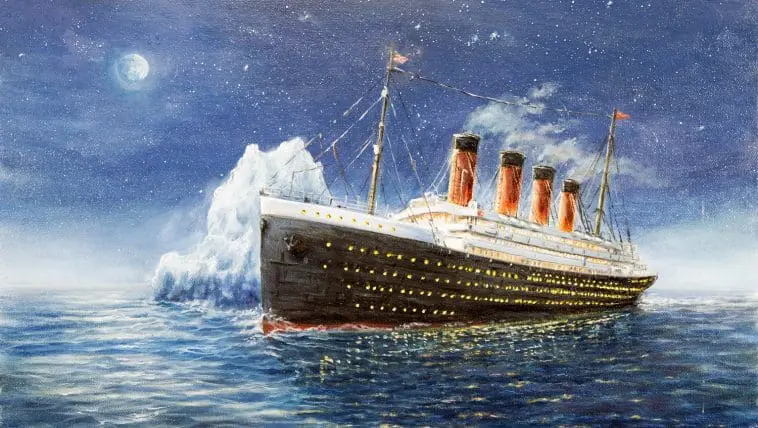
 This animation illustrates the last two hours and forty minutes of the Titanic following its collision with the iceberg, at 11:40 pm on Sunday, April 14, 1912. Photo credit: Artistosteles.
When the Titanic collided with the iceberg, it set in train a sequence of events that continued for more than two hours until the ship reached a new equilibrium on the ocean bottom. A catastrophe involving such a large object takes time to unfold.

After the Titanic struck the iceberg, water gushed into the starboard side of the ship near its prow. Although the flow of water was large, it took several hours to cause the ship to sink because of its enormous size. As it filled, the prow slowly sank into the ocean, raising the stern.
At around 2:18 am the ship suddenly broke in two. The forward section sank to the bottom of the ocean, while the aft section floated vertically briefly before disappearing beneath the waves and following the prow to the bottom.
This process can be used as an illustration of the catastrophe of Noah’s Flood, which engulfed our globe.
According to the Bible, the Flood began with a breaking up of the fountains of the great deep and the opening of the windows of heaven (Genesis 7:11). The Flood involved a train of events that followed a logical sequence of cause and effect, until the earth reached a new equilibrium.
Because the earth is so much larger than the Titanic, the catastrophe of the Flood took much longer to unfold. The Bible records it lasted for just over 12 months. Ongoing climatic effects continued for hundreds of years.
During Noah’s Flood:
- Vast quantities of water moved over the surface of the earth, eroding the landscape and depositing sediment in enormous sedimentary basins.
- This redistribution of mass caused movement of the earth’s plates.
- This in turn generated huge volumes of molten magma, the movement of which further redistributed mass on the globe—laterally and radially.
- The cooling of the magma also affected the movement of plates and ocean levels.
- Through the process some parts of the earth’s crust gradually sank lower and others rose, until the earth eventually reached a new equilibrium, which we enjoy today.
Geological history is often presented as a list of disconnected events.

We read about sedimentation, erosion, mountain building, volcanic eruptions, and ice ages, each separated from the other by tens of millions of years. With so much time between events they seem to be unrelated. However, by looking at geology as the unfolding of one huge catastrophe that overtook our globe, we can begin to connect the dots.