 Jay Wile
[Originally published in 2013 as Soft Bone Tissue in a Triceratops Fossil]
These are exciting times to be a creationist! Ever since Dr. Mary Schweitzer first demonstrated the existence of soft tissue in a Tyrannosaurus rex fossil that is supposed to be 65 million years old,1 soft tissue has been turning up in all sorts of supposedly ancient fossils. The latest example comes from the Hell Creek Formation in Montana, which is assumed to be about 65 million years old, so the fossil is presumed to be that old as well.
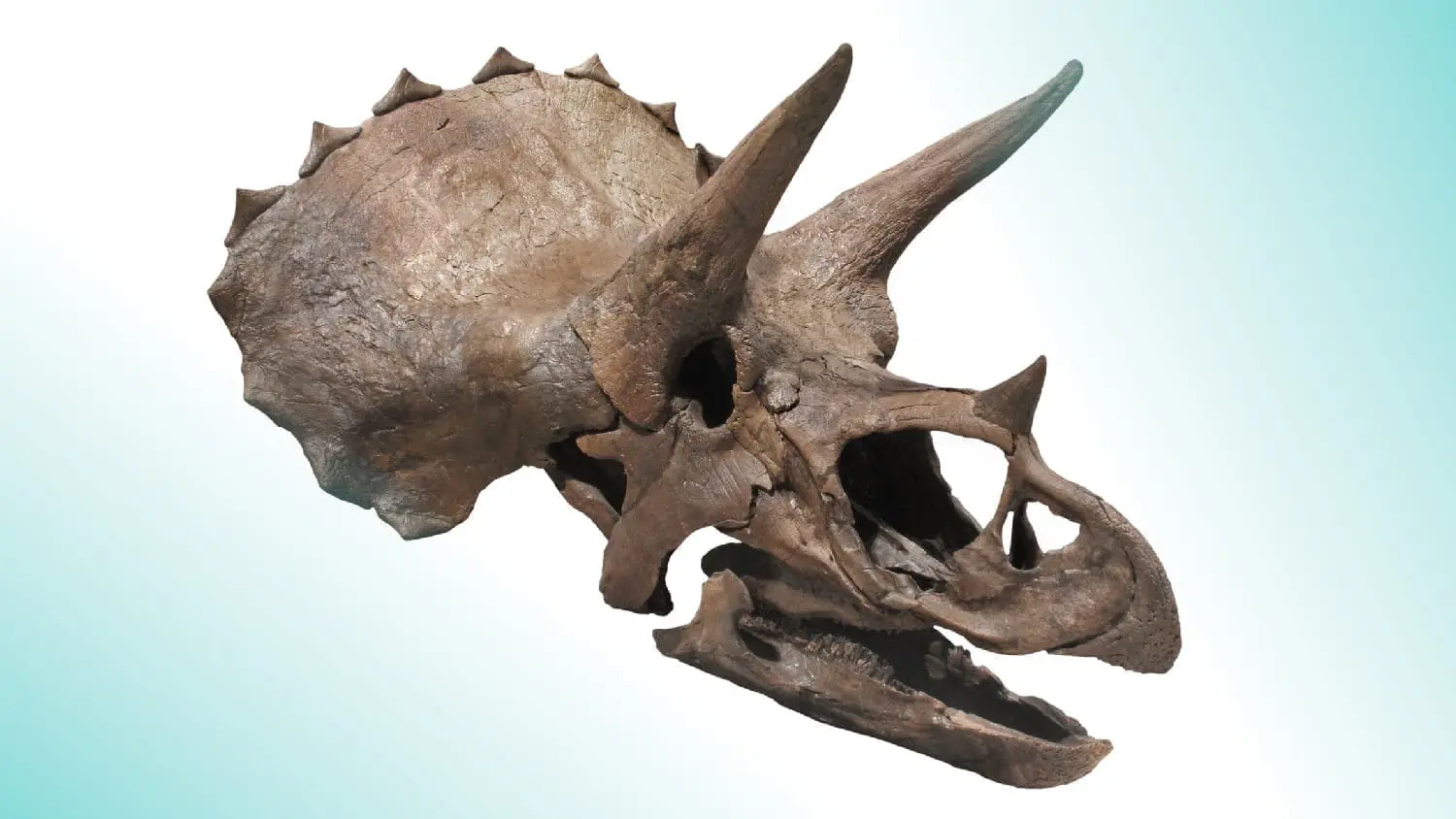
The fossil in question is a horn from a Triceratops horridus specimen. After it was collected, it broke in several places, indicating that the fossil had been fractured. Since the fossil was broken, the authors of the study decided to get rid of the “hard parts” of the fossil to see if there was anything soft inside. To do this, they soaked the horn in a weak acid for a month.

As the acid ate away at the minerals that formed the horn, the authors found strips of light brown, soft tissue remaining. Now this soft stuff could be from all manner of things, so the authors decided to do a microscopic study of the tissue, and what they found was was exactly what you would expect to see if you examined the tissue from the bone of a recently deceased animal!2
When they examined the tissue under a light microscope, they found well-defined, circular Haversian systems. In case you aren’t familiar with that term, compact bone is made of cylindrical structures formed by bone cells that are called osteocytes. The drawing below shows what a Haversian system looks like:
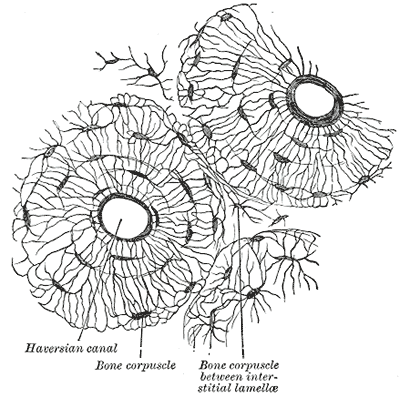 Note that the center of the cylinder is a canal called the Haversian canal. The authors show that the Haversian canals they saw in the tissue were filled with structures that strongly resemble red blood cells!
Since the tissue looks like compact bone tissue, the most reasonable conclusion is that it comes from the Triceratops fossil.
Given that, there is another question to answer: are these Haversian systems fossilized or not? After all, it is possible that the fossilization process is so precise that it preserves structures on the cellular level. Given the fact that the tissue was soft, that’s unlikely, but I suppose it’s still a possibility.
To answer this question, the authors looked at the Haversian systems with a scanning electron microscope, and you can see pictures of what they saw here. The osteocytes that make up the Haversian systems seem completely intact, all the way down to their fragile filipodial extensions. In fact, the authors note:
Filipodial extensions were delicate and showed no evidence of any permineralization or crystallization artifact and therefore were interpreted to be soft.
Advertisement Below:
So it really seems like they were seeing intact, soft osteocytes from a Triceratops fossil found in the Hell Creek Formation. It is hard enough to understand how a bone cell can exist like that for thousands of years. The idea that it has lasted for 65 million years simply boggles the mind.
In my mind, this study is strong evidence against the idea that the fossils in the Hell Creek Formation are millions of years old.
References
- Mary H. Schweitzer, Jennifer L. Wittmeyer, John R. Horner, and Jan K. Toporski, “Soft-Tissue Vessels and Cellular Preservation in Tyrannosaurus rex,” Science, 307:1952-1955, 2005
- Mark Hollis Armitage and Kevin Lee Anderson, “Soft sheets of fibrillar bone from a fossil of the supraorbital horn of the dinosaur Triceratops horridus,” Acta Histochemica, doi: 10.1016/j.acthis.2013.01.001, 2103