 Bryan Melugin
[Originally published as the Defining Evolution 7: Gaining Behaviors and Losing Genes section of Thursday Night Nachos]
Each Thursday, while we wait for our nachos, we — being myself, Bill, Tom, Carl, and Captain Blue Beard — have been engaged in a conversation about a topic which I find is very divisive, with people falling into one of two camps: those who are certain that evolution is (or is not) true, and those who don’t give it any thought at all.
Of course we had our usual table at Danny’s Bar, Grill, and House of Rabblerousing, and our charming waitress, Wendy, brought us our usual root beers. “Your Nachos will be up in a few, guys,” she said. “You boys still talking science while you wait?

“We’re discussing a definition for evolution which Rent-A-Friend invented,” said Tom. He pulled out the note card with the definition written on it and read it to her.
“Evolution is an unguided, natural process which increases the genetic information in an organism, creating new genes which did not previously exist. These new genes then cause an increase in physical complexity and associated behavior, both of which increase the organism’s ability to survive and pass on these traits to offspring.”
“What do you think?” I asked.
“I guess I never thought about it,” she said. “At least, not since high school biology.”
“That puts you in camp two,” I said. “Here, I made you a note card.”
“Thanks,” she said. “This isn’t in place of my tip, is it?”
“No,” I replied. “We’ll also tip you like we always do. Knowledge is valuable, but we know all too well that you can’t pay the bills with it.”
“And don’t think we haven’t tried!” laughed Bill. Wendy winked and headed off.
“Hey, why don’t you guys explain something to me,” said Tom. “The definition doesn’t just call for new parts. It says it must cause an increase in physical complexity and associated behavior. What’s this about associated behavior?”
“An excellent question, Tom,” I said. “I included behavior, because if an animal gains a new physical feature but not the ability to use it, then he will not survive either. If a bug somehow gains the genes to be the same color as tree bark, but it maintains the behavior of spending its time on bright green leaves, it will not benefit from its new fashion style. He must also somehow gain the behavior of hiding out on tree bark.
“If a fish gained the genes to have lungs and legs but not the behavior to breathe with those lungs or walk with those legs, then they are not a help to the fish, and will actually be a terrible hindrance.”
“Legs would be a hindrance?” asked Tom.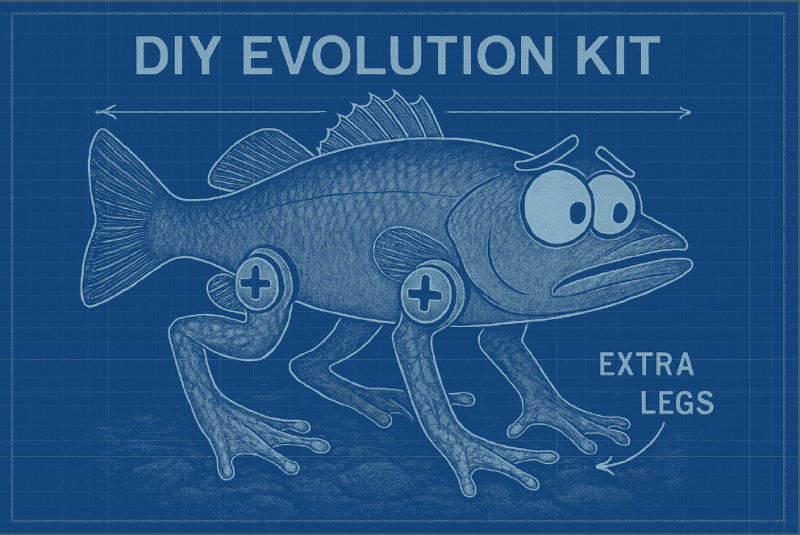
“Super Glue some frog’s legs on a fish some time,” suggested Blue Beard, “and you’ll see what he means.”
“Have you ever plugged a perfectly good webcam into a computer only to find that nothing happens?”
“Sure,” said Tom.

“It’s like that,” I said. “Hardware without the software to make it do what you want does nothing but add dead weight and a cost in resources.”
“If by a series of miracles,” said Bill, “a fish developed a fully formed lung but not the neural pathway connecting it to the part of the brain which controls respiration, or if he got both but not the instinct to come up out of the water to breathe, he would have no benefit either.”
“In other words,” I said, “having a lung does a fish no good if he doesn’t also develop the behavior of coming up out of the water to breathe, and the behavior of breathing.”
“Why are you only concerned with adding physical traits and behaviors?” asked Carl. “Evolution also includes the loss of existing genes, features, and behaviors. Doesn’t a fish lose gills and fins when it evolves into a lizard? Don’t lizards stop swimming?”
“That’s a good point, Carl,” I replied. “It’s true, according to the evolutionary story, that somewhere along the lines this must have happened. In fact, I suspect there would be a loss of genes, structures and behaviors at every transition, but the changes which cause the loss of features and genes are not evolutionary changes.”
“Why not?” demanded Carl.
“Add legs and lungs and other lizard parts to a fish,” I said, “and you will have an all-terrain fish-lizard. Merely remove gills and fins and swim bladder from a fish and you will only have a dead fish. It is the addition of genes for legs and lungs, and the behaviors of breathing air and walking, that make a fish a lizard.”
“Furthermore,” said Bill, “there are lots of changes which create variety within the fish, you see, but if it does not make new physical features that expand the boundaries of its kind, then you are merely making new varieties of fish. If you turn a fish green, he is no closer to becoming a lizard than he was before. Evolutionary changes have to take an animal out of its kind, even if it’s just a tiny step out.”
“I don’t think I get it,” admitted Tom. “If the transitions do involve a loss in genes, structures, and behaviors, then why are you saying those changes aren’t evolutionary changes?”
“OK, Tom,” I said. “Let’s make it super easy and pretend that the only things we need to change to make a fish into a lizard are to add lungs and legs.”
“That’s not realistic,” said Carl. “There are probably hundreds of changes which have to be made.”
“Certainly,” I agreed. “But let’s pretend it’s so simple that it can be done in only two steps. But both must evolve before it becomes a lizard. There are millions of changes which can be made between fish that will never do either of those things: Move the fins around. Move the eyes around. Make them bigger or longer or faster or stronger, and you are still nowhere closer to having a lizard. Lose the gills and scales and fins, and you still don’t have a lizard. You probably make the fish go extinct.
“The point is, if you don’t gain the genes and features for the next step up, losing what you have will never work as a substitute. It’ll most likely just kill you.”
“But couldn’t losing genes and features evolve a kind back into the previous kind?” asked Tom. “Might the loss of some genes make a fish climb back down the tree into worms?”
“That is an interesting idea,” I admitted. “Bill, what do you know about this?”
“This is where our oversimplification works against us,” Bill said. “See, it takes more than the addition of a few parts to make a new kind of plant or animal. A fish isn’t just a worm with some added parts, so that you could take those parts away and have the worm left over.
“A worm had parts, and the genes to make those parts, and the behaviors associated with being a worm which no fish has. So even climbing down the tree, as you say, would require the addition of new genes which the fish does not have.”
“But worms already have those genes!” said Carl. “Those genes already exist, so this would not be an example of needing to create new genes which did not previously exist, which shows your definition to be flawed and useless.” He tossed his note card onto the table with a smug air of victory.
“I know I’ve said this before,” said Blue Beard, “but you really don’t listen, does ya? You done said that a fish doesn’t need to gain new genes that did not previously exist in order to devolve back into worms, eh?”
“That’s right. The genes for worm parts already exist.”
“And how, pray tell, are the fish going to get them from the worms?” The look on Carl’s face was one of dawning comprehension mixed with annoyance. But since he failed to reply out loud, Blue Beard continued. “Perhaps you think the worms might sell them a complete, albeit slightly used set online?”
“See, now you’re just being juvenile,” said Carl. “They’d get them the same way anything gets new genes — mutations. If you knew anything about biology, you’d know that.”
“And are they, by mutations, gaining genes which already existed in the fish population,” asked Blue Beard, “or would these mutations have to create new genes, which did not previously exist in the fish of that fish population?” “They existed in the fish when the fish were worms!” insisted Carl. “All right, lads,” sighed Blue Beard. “Carl’s hit that point where he’s so stubbornly stuck to his position that I’m going to need a helpful metaphor to help him understand it. You guys know what I’m getting at, right?”
“Oh sure,” answered Bill. “Look, Carl, it’s like this. Imagine you are working at that imaginary car factory from a week or two ago. You and Tom are making cars from the same blueprint. Identical cars, you see. In your first year, you add information to the blueprints that adds a mini-fridge to the dashboard so you can have a sandwich in the front seat of the car at any time! But in doing so, you lose the radio. That’s how you have room for the fridge — by losing the radio entirely. Shwoop! Gone! No radio, and now none of your blueprints include the radio.
“The only blueprints you have show a mini-fridge in the dashboard. And one day the company sends you to Mars to run a factory there. So you take a copy of your blueprint, and you go to Mars and open a factory. Do you understand?”
“Yes,” said Carl, annoyed. “Of course. I understood when…”
“But!” continued Bill. “The Martians are not buying the new model! Because Mars has an average temperature of minus sixty-seven degrees! So, the company insists that you go back to making the kind of car which Tom is still making — with a radio.
“But you don’t have that blueprint anymore, and you can’t get it from him because you are on another planet! If you don’t have it, and you can’t get it from Tom, then how are you going to get your factory to make cars with radios so you can sell them on Mars?”
“I’ll have to remove the fridge from my plans and add the radio back in,” said Carl, somewhat bewildered.
“There you go,” said Bill. “You, you see, are the fish. OK? And you do not have the worm radio. You have a fish mini-fridge. But you can’t get Tom’s worm radio. You have to make a new one from whatever you have on Mars. It won’t be Tom’s radio — you no longer have those blueprints. It will be a new Martian Radio. Brand new! Even if by pure chance you wind up designing a radio identical to the one Tom has, it will still have to be made by you on Mars by whatever processes you have to add designs to your blueprint. Thus, new blueprint. New information. New genes.”
“So I’m a fish on Mars making radios?” asked Carl.
“Now he’s got it!” declared Bill.
And with that Bill turned his attention to draining his root beer.
“That’s why,” I said, “even in the case of a fish devolving back into worms, it would be required to increase the genetic information in an organism, creating new genes which did not previously exist.
“I’m not saying there won’t also be losses in genes from time to time, just that those losses are not what grows the Darwinian tree of life, and thus they are not evolutionary changes.”
When the Nachos arrived just a few moments later, Carl was still looking somewhat concerned. I don’t blame him. Being sent to Mars to be a fish making radios from scratch can take it out of a guy. A hefty pile of nachos and a few rounds of darts later, he was all right again.