 Bryan Melugin
Another Thursday get-together at the table near the dartboard to continue our ongoing discussion on the true meaning of Darwinian evolution. We had decided that, before we could argue about if evolution is a fact, we had to know what Darwinian Evolution was. After all, you can’t look for evidence for or against something if you can’t define what it is you’re looking for.
Bill got right to it as he reminded us of an analogy our seafaring friend had displayed at our last Nacho roundabout.
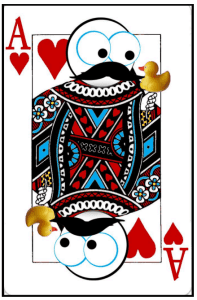 “Captain Blue Beard had made the analogy that shuffling a normal deck of cards will never produce the Archduke of Hearts,” Bill reminded us, “because the deck doesn’t contain it in the first place.”
“Aye!” exclaimed Blue Beard with a frosty mug held high. “Let a thousand monkeys shuffle a thousand decks of cards for a thousand years and one will never have the Archduke of Hearts, or any other card which was not in the original deck.”
Tom made the obvious connection: “The metaphor being,” he said, “that bacteria shuffling the genes it takes to make bacteria will never shuffle enough to make the genes it takes to make a worm or a fish or a cabbage or a wolf.”
“Well spoken, Tom!” shouted Blue Beard, clinking his glass against Tom’s a bit harder than was necessary.
“Some of the monkeys will eat some of those cards,” noted Bill. “You will lose cards even faster than you lose monkeys. But once again, this will never create the Archduke of Hearts. Thus, while shuffling genes can make new variations on the wolf, and losing genes can make horrible mutants like the poodle and Chihuahua, those changes aren’t evolutionary changes because no amount of time will ever allow those changes to make new genes for new features and behaviors.
“You can breed dogs with dogs for a million years, and none of them will ever wind up with the genes it takes to make a moose.”
Blue Beard raised his glass in celebration. “I for one am thankful for that!”
“However you define it,” I added, “evolution tells a story: plant and animal kinds that did not exist in the past — such as cabbages and wolves — exist now, and evolution claims to be the process which created those plant and animal kinds — for example, cabbages and wolves.”
“Building a plant or animal takes genetic information in the form of genes,” said Bill. “In terms of genetics: genes that are necessary to build plant and animal kinds that did not exist in the past, exist now, and evolution claims to be the process which created the genes required to make the plant and animal kinds which exist now.”
“Do you get it, Tom?” asked Blue Beard. “Plants and animals and the genes required to make them exist now, when they did not exist in the past. Not combinations of existing genes which did not previously exist. But the genes individually exist now, and did not exist in the past, and thus somehow came into existence.”
“Sure, I get it,” said Tom. “At one time in the past, wolves and cabbages and the genes required to make them did not exist. Somehow, they now do exist.”
“Evolution claims to be that somehow,” I said.
Carl set his root beer down with some impatience. “I still don’t see what was wrong with defining Darwinian evolution as ‘Decent with Modification,’” he said. “The National Center for Science Education defines it that way. And I’ve got a whole list of other sources which give similar definitions. Why are we arguing about this when professional scientists have already defined the term for us?”
“I think I have a list of concepts which we will all agree must be accepted as we seek to define this slippery term,” I said, fishing out my legal pad from my backpack.
First: Evolution has something to do with living things.
“So, any definition which cannot be specific enough to mean biological evolution is not good enough. For instance, ‘Change over time‘ is too vague, as everything in the universe changes over time. Any definition that would fit things as varied as rocks and social media trends is not specific enough to describe what Darwin was talking about.”
Second: Evolution is something about life changing over time.
“Thus, any definition includes living things staying the same for long periods of time, you are not talking about Darwinian evolution.”
“Hang on,” said Carl, “things do stay the same at different times during the history of evolution. Things aren’t making drastic changes each generation or this whole thing wouldn’t have taken millions of years.”

“Actually,” said Tom, “three and a half billion years.”
“Of course there are periods in the story where things do not change,” I said, “but even if you accept that those periods of stasis happen within the evolutionary history, you would agree that those periods of stasis are not when the evolution is happening. It’s when things do not stay exactly as they were which evolution happens.”
“Come now, Carl,” said Blue Beard. “Even you must admit that! If Evolution is things changing, then it must be something other than long periods of not changing. Right?”
Carl shrugged and dug back into the wings in agreement.
Third: Evolution is something which is intended to explain the origin of different kinds of plants and animals.
“The story Darwinian Evolution tells is that once upon a time there were no — name of plant or animal kind here — but over time evolutionary mechanisms happened until — name of plant or animal — came into being. Thus, any definition which doesn’t explain how new kinds of plants or animals can come into being is not evolution.”
Blue Beard added his two cents. “So if the definition describes changes where in the same species from the past is still here — like getting a haircut, or having a sensible lunch — or if one which was here has gone away — like going extinct — we are not talking about evolution.”
“Just to make sure we agree here,” said Carl, “the definition doesn’t need to specify and describe all of the mechanisms of evolutionary change, right?”
“No, of course not,” I said. “We don’t need expert level specifics. It’s just a definition.” Carl rolled his eyes and I continued.
Forth: Evolution describes the story of all things as a tree of life.
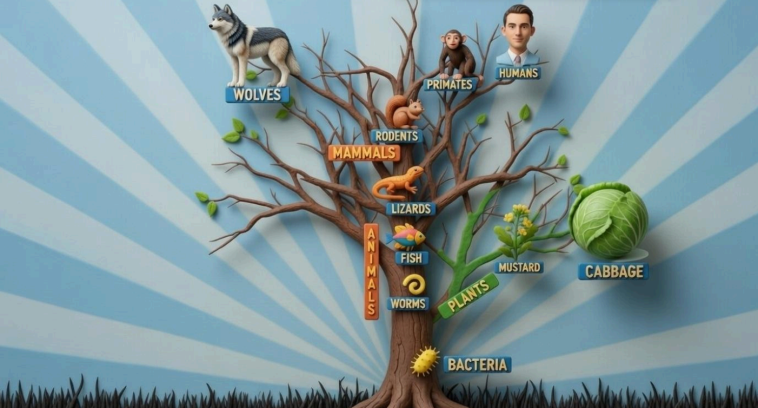
“Evolution describes history such that, if we go far enough back in time, we reach a first universal common ancestor, making the history of life on earth one big tree. Or going forward in time, it explains how simple things like bacteria became worms which became fish which became lizards which became rodents which became primates which became humans.”
“Thus, any definition which fails to account for the growth of the tree is not good enough,” added Bill for clarity. “Extinction events may be fun to watch on Blu-Ray, but they do not grow the tree of life. No species will arise through extinct common ancestors, just to mention one flaw in using extinction in the definition.”
I pulled out one of the illustrations from the previous week showing the Darwinian Tree of Life.
“Is this clear enough? Whatever Evolution is, it must grow the Darwinian Tree of Life, which is the pictorial representation of the history of life on earth which Evolution tells and Evolution is meant to explain.” I turned to Carl, “Any objections?”
“I simply cannot fathom why you require my definition of evolution. It’s simple and can be read on any site,” he scoffed, then shoved some buffalo chicken into his mouth.