
 Chad Arment
[Originally published as Obligate Mutualism: A Creationist Perspective]
Mutualism refers to any ecological interaction between two (or more) different species in which all attain a benefit. The relationship can be facultative (beneficial, but not necessary for survival) or obligate (necessary for survival). Within a mutual relationship, it may even be facultative for one species and obligate for the other.
Another way to categorize these relationships is to determine whether a species is providing a service to or offering a resource for the other species. Within yucca moth—yucca plant mutualism, for example, the yucca moth provides a service (pollination) while the yucca plant provides a resource (seeds in which the yucca moth’s eggs grow).

A Bad argument
Some years ago, a guest speaker at my local creation science group spoke about what he considered evidence for direct design in nature: a form of mutualism, obligate pollination between the vanilla orchid and the small vanilla orchid bee (Melipona sp.). The orchid’s morphology includes a flap (the rostellum) between the stigma and anther which supposedly kept other insects from pollinating these flowers. This speaker argued that if the bee and the vanilla orchid were not created together, at the same time, the vanilla orchid would never have survived.
Yucca moth—yucca plant mutualism
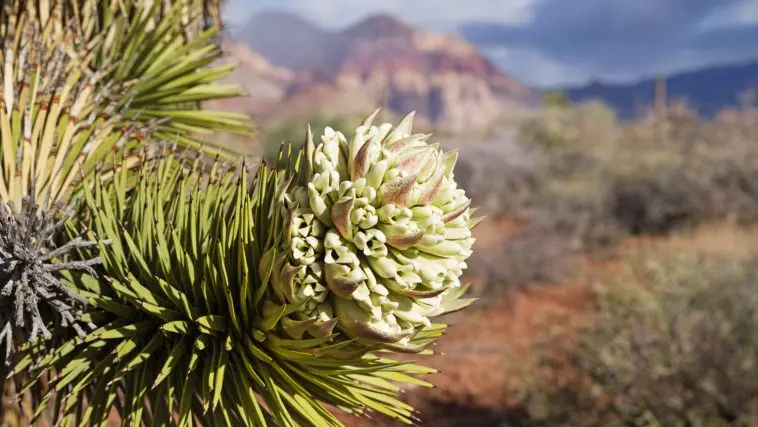
This is a well-known and well-studied relationship. The genus Yucca comprises some 35-50 species within the family Agavaceae (which is sometimes considered a subfamily). Yucca plants require yucca moths for pollination. Yucca moths include the genera Tegeticula and Parategeticula (about a couple dozen species), which along with several other related genera comprise the moth family Prodoxidae. These two moth genera demonstrate obligate mutualism with yucca plants.

Evolutionists suggest that the yucca moth—yucca plant association dates back 41.5 ±1.8 MYA (Pellmyr and Leebens-Mack 1999). This derives from molecular clock suppositions, as there is little fossil evidence. The secular narrative (Pellmyr, et al. 1996) suggests that as yucca plants developed within the Agavaceae, and adapted to desert habitats, they ceased producing nectar (allocating that water for other use). This meant that a broader array of pollinating insects (or other nectivorous species like certain bats) no longer visited those plants.
Because related moths within the Prodoxidae engage in nectaring behavior (probing with the proboscis in search of nectar), and because a similar probing occurs with yucca moths during pollination, it is thought that the moth ancestors colonizing yuccas started out by nectaring, but lost that ability (shifting behavior for a new purpose).
They also likely had certain pre-existing traits such as a preference for woody monocots in arid habitats, larval feeding in flower ovaries, and a specialized cutting ovipositor (Yoder, Smith, and Pellmyr 2010). The initial colonization likely required minimal morphological and behavioral adaptations, while subsequent expression of tentacle appendages cemented the association.
For a creationist, the above narrative has only one major issue: the timeline. It’s very easy to adapt it to a Biblical chronology. After the Flood, as plants and animals were once more expanding throughout a new world, many were pre-adapted in anatomy or behavior to certain situations (or diversified early enough for such pre-adaptations to be available as they reached new territory).

Most subsequent adaptation for yucca plants and yucca moths would be minimal. The yucca plants adapted to a primarily warmer, arid climate (some yuccas are still able to tolerate cooler temperatures and are not uncommon ornamentals), but lost nectivorous pollinators. The yucca moth ancestor was pre-adapted to lay eggs in woody monocots, and found the yucca plants a suitable site for oviposition (eventually losing their nectarivory). The process to pollination behavior may have been stepwise. The development of the tentacle appendage is the most interesting aspect. An evolutionary scenario would be forced to accept this as a fortunate but random event, but from a creationist perspective it is feasible to suggest that this may have been a triggered adaptation. The genetic template was already present.
Dr. Randy Guliuzza has suggested (in his Continuous Environmental Tracking hypothesis, e.g. Hennigan and Guliuzza 2019) that there may be a genetic mechanism which allows an organism to adapt rapidly to the environment. While I disagree with his general assessment that natural selection or other external pressures are of little effect, I don’t disagree that there is likely a genetic toolkit within an organism’s genome that can respond rapidly in certain situations to express a novel morphology or behavior.
In any case, we can see that the yucca plant–yucca moth association is perfectly explainable as a post-Flood derivation. (And as there are numerous individual species involved on both side, the original physical adaptations probably occurred fairly quickly, with consequent speciation events occurring in lockstep for many pairings.)
Interestingly, the obligate mutualism seen here isn’t locked down as an ‘evolutionary dead end.’ One yucca species, Yucca aloifolia, was discovered to be fruiting without the tell-tale oviposition scars from yucca moths (Rentsch and Leebens-Mack 2014). Researchers discovered that European honeybees were effectively pollinating the flowers. It’s possible that natural variation on the part of any pollinators or the pollinatee may provide a way out of an obligate mutualistic relationship. There are also individual ‘cheater’ yucca moths that have moved from mutualism to parasitism (Tyre and Addicott 1993).
These moths oviposit their eggs in yucca flowers without attempting to transfer pollen; some female moths even express vestigial tentacles unable to effectively handle pollen. It’s likely there are distinct species of such ‘cheaters’ within the yucca moth genera (Pellmyr, Leebens-Mack, and Huth 1996). It has also been suggested that some such ‘cheating’ may be a side effect of adaptation to use of a new resource (Pellmyr and Leebens-Mack 2000). This sort of adaptability works well within a creation biology framework, where kinds were created with the ability to adapt and diversify within a constantly-changing environment.
References
- Ackerman, J. D. 1983. Specificity and mutual dependency of the orchid-euglossine bee interaction. Biological Journal of the Linnean Society 20: 301-314.
- Hennigan, T., and R. Guliuzza. 2019. The Continuous Environmental Tracking hypothesis—application in seed dormancy and germination in forest ecosystems. Journal of Creation 33(2): 77-83.
- Pellmyr, O., and C. J. Huth. 1994. Evolutionary stability of mutualism between yuccas and yucca moths. Nature 372(17): 257-260.
- Pellmyr, O., and J. Leebens-Mack. 1999. Forty million years of mutualism: evidence for Eocene origin of the yucca-yucca moth association. Proceedings of the National Academy of Science 96: 9178-9184.
- Pellmyr, O., and J. Leebens-Mack. 2000. Reversal of mutualism as a mechanism for adaptive radiation in yucca moths. The American Naturalist 156: S62-S76.
- Pellmyr, O., and H. W. Krenn. 2002. Origin of a complex key innovation in an obligate insect–plant mutualism. Proceedings of the National Academy of Science 99(8): 5498-5502.
- Pellmyr, O., and K. A. Segraves. 2003. Pollinator divergence within an obligate mutualism: two yucca moth species (Lepidoptera; Prodoxidae: Tegeticula) on the Joshua tree (Yucca brevifolia; Agavaceae). Annals of the Entomological Society of America 96(6): 716-722.
- Pellmyr, O., J. Leebens-Mack, and C. J. Huth. 1996. Non-mutualistic yucca moths and their evolutionary consequences. Nature 380(March 14): 155-156.
- Pellmyr, O., J. N. Thompson, J. M. Brown, and R. G. Harrison. 1996. Evolution of pollination and mutualism in the yucca moth lineage. The American Naturalist 148(5): 827-847.
- Ramírez, S. R., et al. 2007. Dating the origin of the Orchidaceae from a fossil orchid with its pollinator. Nature 448: 1042-1045.
- Rentsch, J. D., and J. Leebens-Mack. 2014. Yucca aloifolia (Asparagaceae) opts out of an obligate pollination mutualism. American Journal of Botany 101(12): 2062-2067.
- Tyre, A. J., and J. F. Addicott. 1993. Facultative non-mutualistic behaviour by an “obligate” mutualist: “cheating” by yucca moths. Oecologia 94: 173-175.
- Yoder, J. B., C. I. Smith, and O. Pellmyr. 2010. How to become a yucca moth: minimal trait evolution needed to establish the obligate pollination mutualism. Biological Journal of the Linnean Society 100: 847-855.
- Yoder, J. B., et al. 2013. Effects of gene flow on phenotype matching between two varieties of Joshua tree (Yucca brevifolia; Agavaceae) and their pollinators. Journal of Evolutionary Biology doi: 10.1111/jeb.12134.