
 Jay Wile
[Originally published as There is No Such Thing…]
In my high school textbook, I try to emphasize the fact that there is no such thing as a “simple” life form. Even the most basic living organism is a marvel of amazing complexity.
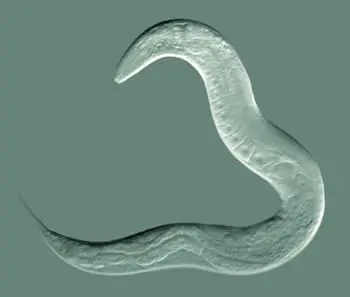
Consider, for example, the tiny roundworm, Caenorhabditis elegans, pictured on the left. It is only 1 millimeter long, and because it is transparent, it is very easy to study. In addition, because its nervous system is considered “simple,” it has been examined extensively in order to understand how animal nervous systems work.

Why is its nervous system considered “simple?”
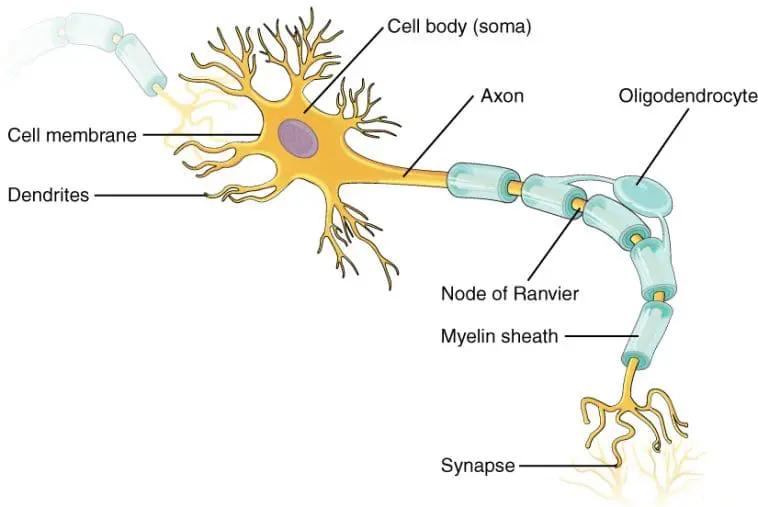
Well, the functional unit of an animal’s nervous system is the neuron, a sketch of which is given above.
These individual cells receive signals in their dendrites and transmit them through the cell body and down the axon. Most animal nervous systems are made up of many, many neurons. For example, in the part of the brain known as the cerebral cortex, cats have about 300 million neurons, dogs have about 160 million neurons, and chimpanzees have about 6.2 billion neurons. The animal with the largest number of neurons in the cerebral cortex is probably the African elephant, topping off at about 11 billion neurons, but the false killer whale comes in as a close second, at about 10.5 billion. By comparison, the cerebral cortex of a person contains about 11.5 billion neurons.1
The entire nervous system of C. elegans is a mere 302 neurons. That’s really simple compared to people and animals isn’t it?
Well…not exactly.
While the number of neurons in this tiny, transparent roundworm is quite low, it turns out that those neurons are significantly more complex than the neurons of other animals!
You see, in order to move from place to place, an animal needs to be able to send signals to its muscles, telling them how to contract and relax. At the same time, however, in order to know what signals to send to the muscles, the animal needs to know the position of the various parts of its body. If its foot is raised off the ground, for example, the signals the brain must send to the muscles are different from when the animal’s foot is resting on the ground.

So in order to move properly, an animal needs to sense the position of its various body parts and then send signals to the muscles of those body parts, telling them what to do.
As far as scientists knew, all animals that move as a regular part of their lifestyle split these jobs between separate nerves. Some nerves (called sensory nerves) carry sensory information to the brain. A subset of those nerves are the ones that tell the brain where the various part of the body are. Other nerves (called motor nerves) carry instructions from the brain to the muscles, telling them how to contract and relax.
Since nerves are composed of neurons, this means that some neurons in an animal’s body are sensory neurons, while others are motor neurons. In other words, animals typically have “specialist” neurons. Some specialize in carrying sensory signals to the brain, while others specialize in carrying motor signals from the brain.
It turns out that this is not the case for C. elegans. In a clever series of experiments, a group of researchers has determined that the neurons in this roundworm do both!2 The researchers used tiny devices to immobilize the worm’s midsection, and they found that while the head of the worm would continue to move, the tail of the worm would not. This seemed to indicate that the tail was getting its instructions to move because it sensed the motion of the midsection. In other words, the tail moves not because the head sends it a signal to move. Instead, it senses the changing position of the midsection, and that’s what tells it to move.
The researchers confirmed this by genetically engineering some C. elegans with a light-sensitive protein in their neurons. This protein allowed the researchers to “turn on” or “turn off” a neuron by shooting it with a laser. They found that the worm would move normally until they hit one of the neurons with the laser. When that happened, all motion behind that neuron stopped. This told them that the neurons involved in the motion of the worm were not only controlling the muscles, but they were also sensing the position of the forward parts of the worm so as to determine what the muscles should do.
This is completely different from how other animals with similar movement capabilities seem to work. If you constrain the movement of a leech’s midsection, for example, its tail continues to move. That’s because the leech has separate sensory and motor neurons going to each section of its body. Even if you constrain the midsection, the brain still gets sensory information from the tail, and it still sends instructions to the muscles of the tail.
So the leech can control the various parts of its body independently, because the brain receives separate signals from and sends separate signals to the different parts of the body. In C. elegans, something completely different happens. Its head sends a single signal down a motor neuron. The other motor neurons in the pathway sense what’s happening in the forward part of the body, and they then instruct the muscles on what to do based on that motion.
As far as I know, this is the first case in which neurons have been shown to serve a dual purpose: sensing information and sending instructions. So does C. elegans have a simple nervous system? While you might be tempted to say “yes” because it has few neurons, the best answer is probably “no,” because those few neurons seem to be more complex than the neurons found in most other animals. In the end, this tiny roundworm once again reminds us that there is no such thing as a “simple” life form!

References
- Gerhard Roth and Ursula Dicke, “Evolution of the brain and intelligence,” Trends in Cognitive Sciences, 9(5):250-257, 2005 (The numbers given come from Table 1.)
- Quan Wen, et. al., “Proprioceptive Coupling within Motor Neurons Drives C. elegans Forward Locomotion,” Neuron, 76:750-761, 2012