
 Caleb Harrelson

[Originally published as Is the Church focusing too much on apologetics and doctrine?]
It is vitally important for Christians to “understand the times” (1 Chronicles 12:32) and respond appropriately in our world, especially to those who are suffering. However, we don’t just respond in any way that culture deems we must. We are called to respond faithfully according to the word of God (2 Timothy 3:15-16).
Scripture is very clear on God’s standards for caring for one another, and it gives us the standard and framework for how to respond to those that are hurting:

- Be quick to listen and slow to speak (James 1:19)
- Encourage confession (James 5:16; 1 John 2:1)
- Show impartiality (James 3:17)
- Be kind and forgiving (Ephesians 4:32)
- Share the gospel and invest in them/disciple them (2Tim. 4; Matt. 28:18-20)
- Point them to honor and seek wisdom in Christ and his Word (Proverbs 1:7; Col 1:15-16; 1 Peter 5:7; Hebrews 4:12)
- Point them to the comfort given the Holy Spirit (John 16) and God’s care for the humble and broken hearted before him (Ps. 34:18)
- Pray for them (James 5:16)
- Offer encouragement (Ephesians 4:29)
- Refute false ideas that hinder people from trusting the Lord and hurt people (2 Cor. 10:3-5; 1 Cor. 13:6; Provers 23:23)
- Refer to those that have special gifting and training in counseling when needed (Proverbs 11:14; 12:18; Gal 6:2; 1 Cor 12)
- Uphold God’s design for the state, under God, to uphold justice and punish evil (Romans 13).
Recently I have seen a quote circling around the internet claiming that the church is focusing too much on doctrine and ignoring those that are hurting. See the quote below to see the exact wording:
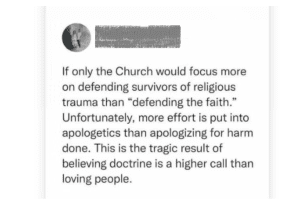
Scripture tells us to test all things (1 Thess. 5:21; 1 John 4:1) and thus we should carefully think through claims like the one above. After thinking over his statement, I have decided that he is committing several logical fallacies.
What is a logical fallacy?
It is when someone has “made a mistake in his or her thinking” (Fallacy Detective, pg 10). Their reasoning is off.
Besides his fallacious assumptions and generalizations, the main fallacy the author makes is the “false-dichotomy fallacy.” This is also known as the “either-or” fallacy. This happens “when someone asserts that we must choose between two things, when in fact we have more than two alternatives.” Furthermore, when someone tries to use this fallacy, usually one of the options is so absurd that we are forced to choose the other option. This fallacy becomes obvious once we realize that there are often more than two choices” (Fallacy Detective, 125-126).
Now, lets carefully think through his reasoning:
- My first question is “what does this person mean by religious trauma?”
If by this he means when someone has been constantly berated, manipulated, shamed, gaslit, or withdrawn from because they don’t support or attend some ministry activity, then yes, I agree that is spiritual abuse. I have experienced a few of these types of abuse and it’s horrible. I went to counseling in the past to recover from it.
Spiritual abuse is real and we need to make a good apologetic for biblical justice and church discipline when spiritual abuse happens.
However, if by this he means “teaching that affirms the Biblical view of marriage, identity, sin, the exclusivity of Christ, and the sober reality of hell” then he is communicating something very different. If this meaning is the case, he is seeking to persuade people to his position by appealing to emotion rather than by careful reasoning with defined terms. The concern with a rhetorically powerful statement such as in quote above is that it doesn’t unpack how the author is defining “religious trauma.” We can be highly offended by something that is taught in the Bible, but that doesn’t mean our offense is justified or that all of the American church is at fault.
Also, it should be noted that sometimes people affirm good doctrine, but then they can still use their platform to manipulate others to gain power and influence. Sadly, when that happens many people automatically assume that the doctrine itself is the problem instead of the abuse of power built by true doctrine perpetrated by said person.
It is self-refuting to argue against the defense of the faith, when it seems that this person would at least agree that “bad ideas are what led to someone experience religious trauma in the first place.” Right doctrine and belief are intended to always lead to right behavior. In fact this truth is affirmed in Romans 12:1-2 when we are told by the apostle Paul to “renew our minds” and make our lives a “living sacrifice.”
Thus, the answer to bad teaching can’t be less good teaching and more empathy/feelings. Proper empathy presupposes a standard of objective right and wrong for proper outrage to even be expressed. (i.e., you don’t want to empathize with someone who is upset about not getting to do something wrong and against God’s commands). Michael Kruger affirmed a similar point to this in one of his recent books when he said this:
Another issue …is this dichotomy it creates between behavior and doctrine. The former is simply more important than the latter, we are told. But the problem here is that the two cannot be so easily divided. Indeed, any declaration about right or wrong behavior is a theological declaration! One cannot determine godly behavior in the absence of sound theological categories and concepts, for behavior is only “right” if it fits with God’s law and God’s character. (Michael Kruger, Ten Commandments of Progressive Christianity, pg. 23)
Kruger also says this about the healing power of teaching good theology:

“Teaching people good theology is not the problem, but the solution. Teaching people good theology is vital, essential way of caring for them. Rather than viewing theology as something that harms and oppresses people, we should be reminded that good theology actually comforts and liberates people. The Pharisees harmed people precisely by teaching them (and modeling for them) bad theology.” page 22.
Spiritual abuse flourishes where false doctrine abounds. Bad theology hurts people and good theology is what it takes to reject the poisonous lies and heal. For example, being taught that we must be constantly good enough to stay saved causes intense suffering. The solution is to find the freedom God offers through the truth of his Word that it is never us holding onto salvation in our own strength that keeps us in God’s kingdom; it’s Jesus’s payment and empowerment that keeps us safe in him forever!
But what about how much of a emphasis churches have on apologetics and teaching good doctrine compared to trauma recovery and just loving people?
The truth is that most churches in America don’t actually focus much on apologetics. Those that do usually host classes that tend to attract fewer people than a recovery group. Statistically, churches in America are not focused on theology, doctrine and apologetics as they should. Thus, the original point from the quote above can’t even be supported.
Since many apologetics ministries have a highly visible presence online and at conferences, it’s easy for people to feel as if everyone in the American church is focused on apologetics. That’s not the case. In fact, I spend a large chunk of my time trying to show other Christians why scriptures supports apologetics in the first place!
Both Truth and Love
It is a false-dichotomy to assume someone can only focus on either apologetics or loving empathy for suffering people. Apologists put out a lot of content publicly because we love the church and we love lost people and want them to come to know Christ. For example, the One Minute Apologists, Bobby Conway, supports both apologetics and mental health, counseling and recovery. I praise God because of guys like him.
I would argue that good recovery (from spiritual, physical and emotional abuse) depends upon good theology and apologetics. Any group that is encouraging recovery apart from a high regard for truth as found in God’s Word is not truly promoting recovery, but is just an emotional support group.
Yes, there are people who care about doctrine but do not listen well to others. This is exactly why I teach the “Columbo tactic” that expressively shows us how to love and listen to people well and engage with them about the truth. Doctrine, truth, apologetics, and listening go hand in hand. When they do not, it’s because that person is being prideful, not because the truth is dangerous to the soul.
Bad ideas shape how people think about issues of morality, justice, marriage, purpose and so on. There is no neutrality on these topics. Since Christ has “all authority on heaven and earth” (Matt. 28:18-20), part of discipling is lovingly pointing out to both large audience (I.e. online, public events) and in personal discipleship why God’s Word should be trusted and obeyed in all matters.
The primary goal of a pastor is to publicly exposit the Word of God, rebuke false teachings and make disciples. Truth sets people free (John 8:31-32) Love never separates itself from truth. Love without truth is indifference or self-love, and truth without love is just harsh. We must “speak the truth in love” (Eph. 4:15). Both work together.
In fact, many of the people who need personalized counseling agree that false doctrine/teaching (i.e. prosperity gospel, legalism, self-help, new age, “follow your heart”) fueled their soul pain. It was bad theology that led others to take advantage of them, and bad doctrine that convinced them such behavior was normal and what they deserved.
People who have left false teachings have a special hatred for the false doctrine that shaped their past because of how they harmed them and consequently they now have an acute love for good doctrine and apologetics. Love delights in the truth.
If we truly believe that the gospel is powerfully changing lives and that God’s word is sufficient for the believer (2 Tim 3:15-16; Rom 1:16), then we must defend the “faith once for all delivered to the saints” (Jude 3). It’s the most loving thing we can do.