 New Creation
[Originally published as the second part of A Biblical Perspective on Plate Tectonics]
By Christian Ryan
We do not often think of Planet Earth as a living thing. But in a way, it is. The Earth is an active system with volcanoes on land and at the bottom of the sea, fluctuations in sea level, earthquakes, marching and melting of glaciers, and climate changes. Not to mention all of the biological processes. Yes, all of these processes are governed by a phenomenon that lies beneath our feet: plate tectonics…

Recent & Rapid Rise of Mountains
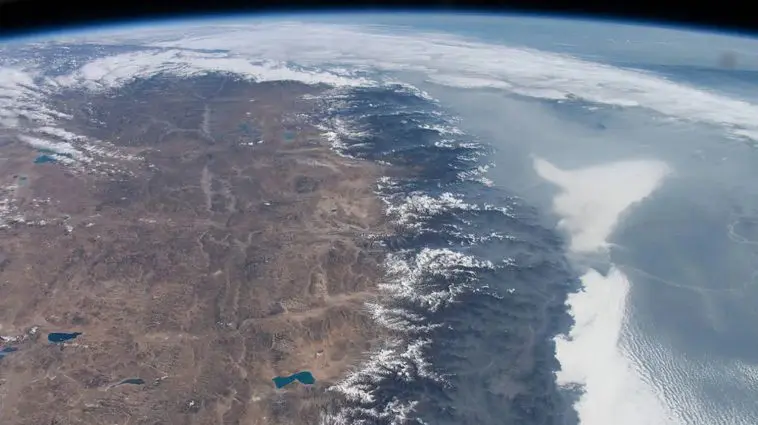
A planation surface is a large-scale land surface that has been eroded almost flat. Interestingly, many of these surfaces are now high-elevation plateaus, such as the Tibetan Peninsula shown above. This requires that the erosion that caused the planation surface happened first, followed by an uplift.
This is inconsistent with the idea that slow-and-gradual plate tectonics we observe today was responsible for the uplift of these high-elevation plateaus.1 Over millions of years, erosion would have etched away at the surface of these plateaus, sculpting a topographic landscape into them. The fact that such uneven erosion did not occur suggests that erosion started to carve the planation surfaces into mountain peaks only after they reached their near-current heights.
It’s All in the Physics
As soon as such programming was possible, Dr. Baumgardner developed a Fortran-based computer program to better model how CPT could work. Called TERRA, this program allows researchers to mathematically set and manipulate a model of the Earth in both two and three-dimensions. With this program, Dr. Baumgardner has been able to demonstrate that even with all geophysical parameters and laws of physics in place, runaway subduction is physically possible.2
Computational fluid dynamics expert Dr. Hans Ruppel from Los Alamos National Laboratory, served as a peer reviewer for Baumgardner’s 1986 publication on the geophysics of CPT. He expressed strong disagreement with Baumgardner’s attempts to align the geologic record with a biblical timeline. Nevertheless, he still praised the core science, writing: “The proposed mechanism for cataclysmic tectonic upheaval and the discussion of the temperature dependence of the mantle viscosity are scientifically credible.”3
He further added that the simulations offer “new insight into the history of the Earth’s mantle and are important to pursue, independent of their theological implications.”4
A Graveyard of Oceanic Crust
We have already discussed the process of oceanic crust disappearing into the Earth’s mantle during subduction. But what happens after that?
For decades, most geologists assumed that they simply accumulated and assimilated into the upper mantle. The temperature of the Earth’s upper mantle ranges from 1,160°F (627°C) to as high as 1,700 °F (930°C) near the top of the lower mantle. This is about 420 miles (670 km) below the Earth’s surface. Surely, subducted oceanic plates should not still be present after tens of millions of years.

But Dr. Baumgardner disagreed. In the early 1980s, he argued that if CPT was responsible for runaway subduction only a few thousand years ago, the oceanic crust slabs should still be present. Not only this, but he also predicted that they were being subducted so quickly that they penetrated downward through the upper mantle and ended up at the base of the lower mantle.
Ten years later, geophysicists, using a technique called seismic tomography, discovered that slabs of “cold” crustal material were still located at the base of the mantle, despite reaching temperatures in excess of 7,232°F (4000°C). This is exactly where Dr. Baumgardner’s model predicted they would be.5
Areas of Further Research
While plate tectonics, along with its catastrophic variant, are by far the most explanatory tectonic models, many mysteries remain for both old-earth and young-earth geologists to solve.
The Dawn of Plate Tectonics
How and when plate tectonics started is a complex and controversial topic. To date, there is no consensus among old-earth geologists regarding either one. Some think it started as early as four billion years ago, while others think it did not really kick off until one billion years ago.6
As far as young-earth geology is concerned, suggestions for the actual cause range widely. They include asteroid or cometary impacts, a buildup of radioactive heat beneath the Earth’s crust, the direct hand of God, and many, many others.7
There is also an open question as to when plate tectonics began. Most young-earth geologists think it initiated with the Flood, when slabs of oceanic crust broke loose and subducted along thousands of miles of pre-Flood continental margins.8 Some have suggested it began sometime between the Fall and the Flood. According to this idea, plate tectonic activity gradually became more and more prevalent, eventually culminating in the Flood.9 Unlike the more widely accepted variant of CPT, this pre-Flood plate tectonics model has not yet been replicated with computer modeling, so more research is needed.
It’s Getting Hot in Here!
In order to form the entire oceanic crust during the year-long Flood, this newly formed rock would need to expel great quantities of heat as it cooled. Estimates suggest this cooling process released some 1.4 x 1029 joules of heat, which is 30 times more than enough heat to completely boil off Earth’s oceans!10
Since Scripture specifically states God’s involvement during the Flood year, some — like Baumgardner — suggest we should remain open to the possibility that some supernatural cooling mechanism may have been involved. On the other hand, gaps in our knowledge do not necessarily mean that no naturalistic explanation exists. Researchers in antiquity assumed many phenomena in nature to have supernatural causes, only for science to later discover a natural cause behind them.

Regardless of how we account for the Flood’s heat budget, the fact remains that there are several lines of evidence suggesting plate tectonics occurred much faster in the past than it does today. The existence of this heat problem does not make this evidence simply vanish.
All in Good Time
Most CPT advocates agree that Pangaea was not the original supercontinent. Instead, that title usually goes to another, even earlier supercontinent: Rodinia. It had an entirely different continental arrangement from Pangaea.
The logic for this reasoning is simple. The Appalachian Mountains of North America, the Atlas Mountains of North Africa, and the Caledonian Mountains of the British Isles and Scandinavia formed as a single mountain range called the Central Pangean Mountains. These mountains are composed of fossil-bearing rock layers that young-earth geologists think were formed earlier during the Flood. This means the layers were formed in North America, Europe, and Africa. Afterward, the continents came together to form Pangaea, creating the mountains.11
However, there is a problem with breaking apart Rodinia and reassembling it into Pangaea. Once Pangaea formed, it would be surrounded by newly formed oceanic crust that is too buoyant to subduct. So to start another cycle of runaway subduction, the oceanic crust would need time to cool. In the Flood model, this cooling would have no more than a few days to elapse. As a result, Pangaea would be unable to break apart again.12
In response, some young-earth geologists have suggested that the original supercontinent was a type of proto-Pangaea, rather than Rodinia. According to this model, proto-Pangaea has a narrow sea running through it that still allows for early Flood subduction and the creation of the Central Pangaean Mountains. It also reduces the plate motion required by not having to transform Rodinia into Pangaea.13,14
Conclusion
The Catastrophic Plate Tectonics model has allowed creationists to achieve a greater understanding of Earth’s history than ever before. It allows us to come up with plausible explanations for how God flooded the Earth. Additionally, it provides powerful evidence that plate tectonics operated much faster than it does today.
It also opens up new avenues for research, such as: The investigation into how and when tectonic activity began. The timing of when supercontinents formed and were broken up. Discovering how so much heat was expelled from Earth’s system during the Flood.
Plate tectonics has been a wonderful discovery for creationists because it allows us to more clearly see just one of the incredible ways God orchestrates geologic change to the surface of the planet He created.
Footnotes
- Ollier, C. and C. Pain. 2000. The Origin of Mountains. Routledge, London
- Baumgardner, John R. (1986). “Numerical Simulation of the Large-Scale Tectonic Changes Accompanying the Flood.” Proceedings of the International Conference on Creationism: Vol. 1, Article 56.
- Ibid.
- Ibid.
- Baumgardner, J.R. 2003. “Catastrophic plate tectonics: the physics behind the Genesis Flood.” pp.113-126 in: Ivey, R.L., Jr. (ed.), Proceedings of the Fifth International Conference on Creationism. Creation Science Fellowship, Pittsburgh, Pennsylvania.
- Y., Ol, B., & Na, A. (2024). “Geology’s biggest mystery: When did plate tectonics start?” Nature, 632, 491.
- Austin, Steven A.; Baumgardner, John R.; Humphreys, D. Russell; Snelling, Andrew A.; Vardiman, Larry; and Wise, Kurt P. (1994). “Catastrophic Plate Tectonics: A Global Flood Model of Earth History.” Proceedings of the International Conference on Creationism: Vol. 3, Article 56.
- Ibid.
- Coulson, K. P. (2021). “Using Stromatolites to Rethink the Precambrian-Cambrian Pre-Flood/Flood Boundary.” Answers Research Journal, 14, 81–123.
- Worraker, W.J., and R. Ward. (2018). “Modeling of Flood and post-Flood ocean floor cooling.” In Proceedings of the Eighth International Conference on Creationism, ed. J.H. Whitmore, pp. 673–682.
- Akridge, A. J., Bennett, C., Froede, C. R., Jr., Klevberg, P., Molén, M., Oard, M. J., Reed, J. K., Tyler, D., & Walker, T. (2007). “Creationism and catastrophic plate tectonics.” Creation Matters, 12(3), 1, 6-8.
- Froede, C. (2002). “The Wilson cycle: a serious problem for Catastrophic Plate Tectonics.” Journal of Creation 16(3):108–110.
- Baumgardner, J. 2018. “Understanding how the Flood sediment record was formed: The role of large tsunamis.” In Proceedings of the Eighth International Conference on Creationism, ed. J.H. Whitmore, pp. 287–305.
- Clarey, T.L., and D.J. Werner. 2018. “Use of sedimentary megasequences to re-create pre-Flood geography.” In Proceedings of the Eighth International Conference on Creationism, ed. J.H. Whitmore, pp. 351–372. Pittsburgh, Pennsylvania: Creation Science Fellowship.